
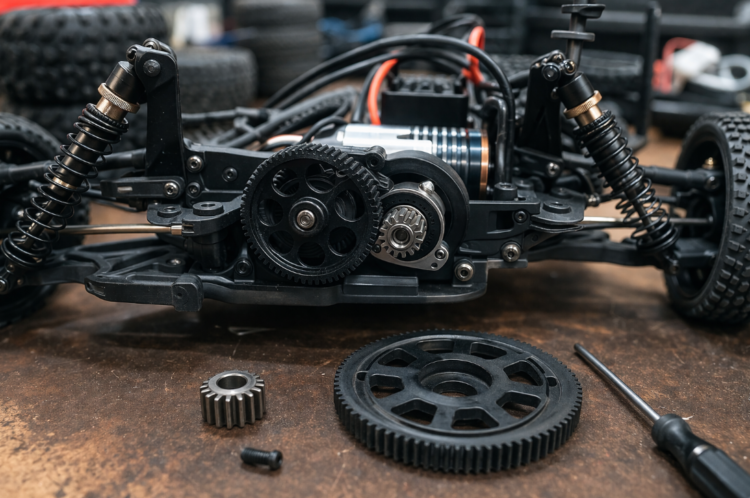
I still remember the first time I messed with my RC car’s gear ratio. I thought, “Hey, bigger pinion gear = faster car, right?”
Yeah… it was faster—for about three minutes. Then the motor got so hot it could’ve cooked breakfast.
That’s when I realized gear ratio tuning isn’t just about speed. It’s about balance. And if you get it wrong, your RC car will let you know immediately.
So here’s a real-world, no-BS breakdown of gear ratio tuning—based on what actually works, not just what the manual says.
What Gear Ratio Actually Means (In Plain English)
Think of your RC car like a bicycle.
- Low gear → easier to pedal uphill (more torque)
- High gear → faster on flat ground (more speed)
Same exact concept applies here.
Your gear ratio basically controls how your motor’s power turns into either:
- Speed (top end)
- Torque (acceleration and climbing power)
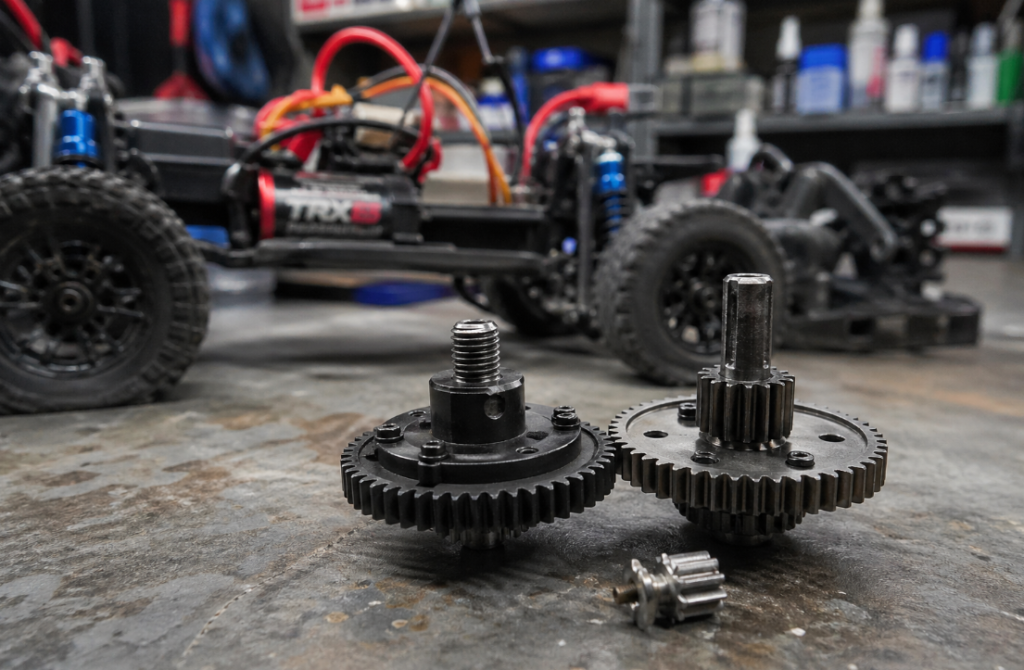
Speed vs Torque – The Trade-Off Everyone Learns Eventually
You don’t get both. Not fully, anyway.
When I Tuned for Speed
I swapped to a bigger pinion gear and smaller spur gear.
What I got:
- Insane straight-line speed
- Looked amazing on pavement
- Felt like I built a mini rocket
What I didn’t expect:
- Weak acceleration
- Motor overheating fast
- Totally useless off-road
This setup is great if you’re just blasting across parking lots or racing on smooth surfaces.
When I Tuned for Torque
Then I went the opposite direction—smaller pinion, bigger spur.
Completely different car.
- Way stronger acceleration
- Climbed dirt hills like nothing
- Much better control off-road
Downside?
- Slower top speed
But honestly, for real-world driving, this setup was way more fun.
The Two Parts That Actually Matter
If you’re going to tweak anything, it’s these two:
1. Spur Gear (The Big One)
- Bigger spur gear → more torque
- Smaller spur gear → more speed
2. Pinion Gear (The Small One on the Motor)
- Bigger pinion → more speed
- Smaller pinion → more torque
That’s it. Those two control everything.
How I Calculate Gear Ratio (Simple Version)
Here’s the basic formula I use:
Gear Ratio = Spur Gear ÷ Pinion Gear
Example:
- Spur: 48T
- Pinion: 12T
That gives you 4:1
If your car has internal gearing (most do), multiply that in too.
You don’t need to overthink it—just know:
- Higher number = more torque
- Lower number = more speed
My Step-by-Step Tuning Process
This is literally what I do every time:
Step 1: Check Current Setup
I look at what gears I’m running now. If I don’t remember, I just open it up and check.
Step 2: Decide What I Want
- Want more speed? Go bigger pinion
- Want more torque? Go smaller pinion
I usually change just 1–2 teeth at a time. Anything more is risky.
Step 3: Install and Adjust Backlash
This part is huge.
I use the “paper trick”:
- Put a piece of paper between gears
- Tighten them together
- Remove paper
Perfect spacing every time.
Step 4: Test Run
After a quick run, I always check:
- Motor temp
- Acceleration feel
- Top speed difference
If the motor feels too hot to touch, I went too far.
Mistakes I Made So You Don’t Have To
1. Going Too Aggressive on Speed
Biggest mistake ever.
More speed = more heat
More heat = shorter motor life
Simple math.
2. Ignoring Motor and ESC Limits
Not all setups can handle aggressive gearing.
If you’re pushing higher voltage (like 3S or 4S), you need to be even more careful.
3. Bad Gear Mesh (Backlash)
Too tight:
- Grinding
- Heat
- Gear damage
Too loose:
- Noise
- Power loss
Get this right and your car runs smooth.
One Thing Most People Overlook: Tires
This surprised me.
Bigger tires:
- Increase load
- Reduce speed
- Add torque demand
Smaller tires:
- Increase speed
- Reduce strain
So yeah, your gear ratio and tire size are connected whether you like it or not.
My Personal Sweet Spot
After a lot of trial and error, I usually go for a balanced setup:
- Slightly torque-biased gearing
- Good acceleration
- Enough speed to still have fun
Because let’s be honest—unless you’re racing, torque is way more useful than max speed.
Gear ratio tuning is one of the easiest ways to completely change how your RC car feels.
You don’t need expensive upgrades. Just a few gears and some patience.
Start small, test often, and don’t chase speed at the cost of everything else.
If you’re into RC upgrades and want to dive deeper, I’ve shared more hands-on tweaks here:
- https://trvbaby.net/rc-car/rc-maintenance-fix/rc-car-upgrades-worth-it/
- https://trvbaby.net/rc-car/rc-maintenance-fix/rc-car-tuning-tips-simple-upgrades/
Those helped me avoid a lot of costly mistakes early on.