Types of RC Cars Explained: On-Road vs Off-Road
If you’ve ever searched for RC cars online, you’ve probably noticed something strange. Two cars can look almost the same in photos—but behave completely differently once they hit the ground.
One glides smoothly across pavement.
The other bounces over dirt like it doesn’t care about physics.
That’s because RC cars are built for very different environments, and understanding those differences early can save beginners a lot of confusion later. This guide breaks down the two main types of RC cars—on-road and off-road—without marketing fluff or hobby-shop pressure.
Just clear explanations.
The Two Main Categories of RC Cars
At the highest level, RC cars fall into two broad categories:
- On-Road RC Cars
- Off-Road RC Cars
Everything else—monster trucks, buggies, short course trucks—fits under one of these umbrellas.
What Are On-Road RC Cars?
Designed for Smooth Surfaces
On-road RC cars are built to operate on:
- Asphalt
- Concrete
- Smooth pavement
- Indoor tracks
They prioritize speed, stability, and precision over obstacle handling.
[ Radio-controlled car – Wikipedia ]
Key Characteristics of On-Road RC Cars
Low Ground Clearance
On-road RC cars sit close to the ground. This lowers the center of gravity and improves handling at higher speeds.
Slick or Semi-Slick Tires
These tires are designed for grip on smooth surfaces, not dirt or grass.
Stiff Suspension
Less suspension travel means more predictable handling on flat terrain.
Common On-Road RC Car Types
- Touring Cars
- Drift Cars
- Pan Cars
- Formula-Style RC Cars
On-road platforms reward smooth control. Small steering inputs matter—a lot.
What Are Off-Road RC Cars?
Built for Uneven Terrain
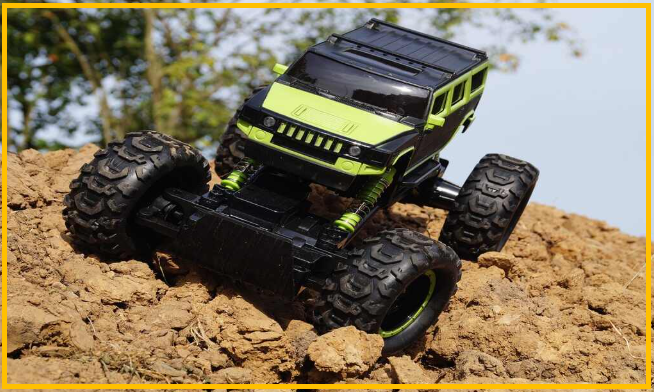
Off-road RC cars are designed to handle:
- Dirt
- Gravel
- Grass
- Mud
- Rough trails
Instead of speed alone, they focus on durability and traction.
Key Characteristics of Off-Road RC Cars
Higher Ground Clearance
This allows the car to clear rocks, bumps, and uneven surfaces without bottoming out.
Aggressive Tires
Deep tread patterns help maintain grip on loose surfaces.
Long-Travel Suspension
More suspension travel absorbs shocks and protects internal components.
Common Off-Road RC Car Types
- Buggies
- Monster Trucks
- Short Course Trucks
- Rock Crawlers
Each of these serves a slightly different purpose, but they all prioritize terrain handling over top-end speed.
On-Road vs Off-Road: The Real Differences That Matter
Driving Experience
On-road RC cars feel precise and responsive. Off-road RC cars feel forgiving and rugged.
Beginners often think faster equals better—but control matters more than speed when learning.
Maintenance Differences
Off-road RC cars:
- Get dirty faster
- Require more frequent cleaning
- Experience more mechanical stress
On-road RC cars:
- Stay cleaner
- Have fewer impacts
- Still require inspection, just less often
General RC maintenance concepts are explained in more detail across beginner-friendly posts at
👉 RC Car Maintenance Basics Explained for Beginners
Durability Expectations
Off-road RC cars are usually more durable out of the box. On-road RC cars are not fragile, but they are less tolerant of crashes into curbs or debris.
Which Type Is Better for Beginners?
There is no universal “best,” but there is a better fit depending on where you plan to drive.
Choose On-Road If:
- You have access to smooth pavement
- You enjoy precision driving
- You prefer cleaner operation
Choose Off-Road If:
- You drive on grass, dirt, or trails
- You want durability
- You expect bumps and jumps
If you’re still learning RC fundamentals, beginner explanations across
👉 What Is an RC Car? A Beginner’s Guide to How RC Cars Really Work
can help you decide without rushing into purchases.
Can On-Road and Off-Road RC Cars Be Converted?
Technically, some parts can be swapped—but practically, conversions are limited.
Tires, suspension geometry, and drivetrain design are optimized for specific environments. Trying to force one type into the other often leads to frustration.
Why Understanding RC Car Types Matters
Many beginners assume problems come from “bad quality” RC cars. In reality, they’re often using the wrong type for the surface.
An on-road RC car driven on grass will struggle.
An off-road RC car on smooth pavement may feel unstable at speed.
Understanding categories prevents unnecessary repairs and disappointment.
Internal Systems Are Similar Across Types
Despite surface differences, both on-road and off-road RC cars share core systems:
- Transmitters
- Receivers
- ESCs
- Motors
- Batteries
How these systems work together is explained step-by-step in RC basics content available at
👉 Redcat Racing Parts Guide
Frequently Asked Questions (FAQ)
Are off-road RC cars slower than on-road RC cars?
Generally, yes. Off-road cars trade top speed for traction and durability.
Can beginners start with on-road RC cars?
Yes, if they have smooth driving surfaces and understand the handling differences.
Do off-road RC cars need more maintenance?
They usually require more cleaning due to dirt and debris exposure.
Is one type more expensive than the other?
Cost varies by model, not category. Both types have beginner-friendly options.
Can RC cars be used indoors?
On-road RC cars are better suited for indoor use with proper space.
Final Thoughts
RC cars aren’t one-size-fits-all machines. They’re tools designed for specific environments.
Once beginners understand the difference between on-road and off-road RC cars, everything else—handling, maintenance, expectations—starts to make sense.
And that understanding makes the hobby far more enjoyable.