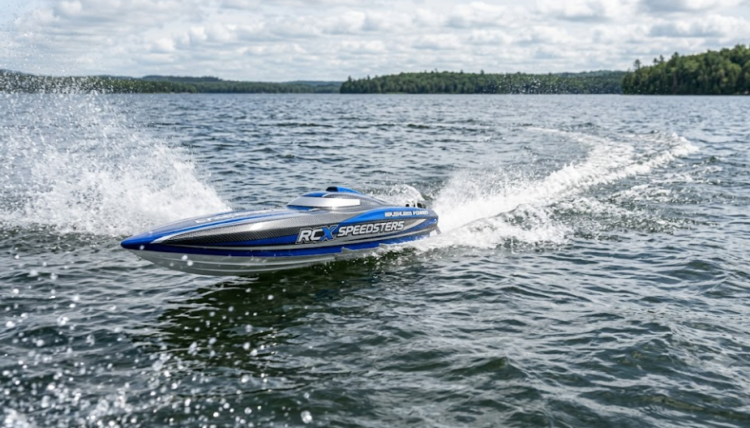
I still remember the first time I watched an RC boat rip across a lake so fast it left a wake like a real speedboat. I went home that night and bought the wrong one. Turns out “fast” on the box and “fast” on the water are two very different things, and it took me a few soaked shoes and one dead battery to figure out why.
Why Most People Get “Fast” Wrong
If you search for the fastest RC boat, you’ll get a wall of specs shouting numbers like 30 mph, 40 mph, even 60 mph. I’ll be honest with you, most of those numbers are measured under lab conditions that nobody’s local pond will ever match. Wind, chop, hull weight, and battery voltage all eat into that headline number before your boat even touches the water.
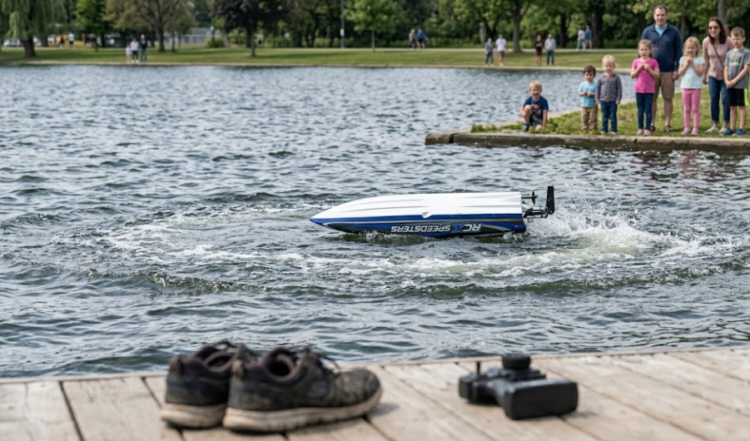
In my experience, the boats that feel the fastest aren’t always the ones with the biggest number printed on the packaging. A boat that handles a little wind and still tracks straight at speed will always beat a “faster” boat that flips the second you push the throttle past half. I learned that lesson the hard way after my first boat did a full barrel roll in front of a group of kids at the park. Not my proudest hobby moment, but a useful one.
What Actually Makes an RC Boat Fast
Motor and Battery Setup
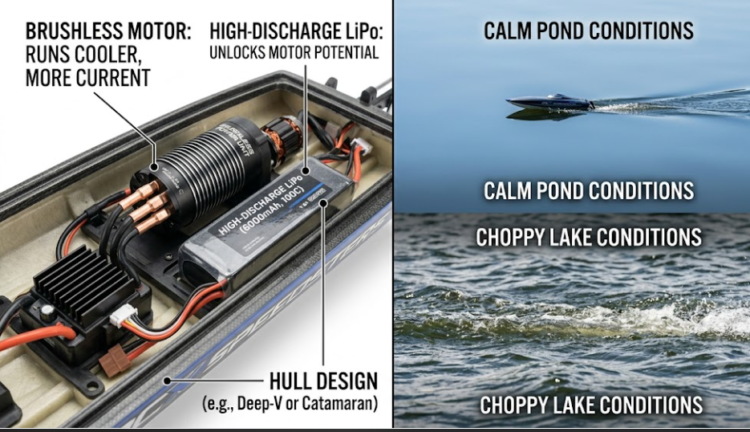
Brushless motors are the real dividing line here. If a boat is running a brushed motor, you can pretty much stop reading the spec sheet, because it’s not going to compete with anything brushless. Brushless setups run cooler, pull more current without burning out, and simply have more headroom for speed. Pair that with a decent LiPo battery, and you’ve got the two pieces that matter most.
I’ve swapped batteries on a mid-range boat before and picked up a noticeable jump in top speed without touching anything else. A higher-capacity, higher-discharge-rate LiPo lets the motor pull the current it actually wants instead of choking on a weaker cell. It’s a small change that makes a bigger difference than most people expect.
Hull Shape and Stability
This is the part a lot of first-time buyers skip past. A deep-V or catamaran hull cuts through chop way better than a flat-bottom hull, which tends to skip and bounce once you’re past a certain speed. If you ask me, hull design matters just as much as raw power, maybe more, since a boat that can’t stay stable at top speed is basically useless the moment there’s any wind at all.
Catamaran hulls in particular tend to plane out and stay locked in a straight line once they hit their stride, which is part of why so many dedicated speed boats use that twin-hull design. Deep-V hulls handle rougher water better but usually trade off a little bit of that top-end speed in exchange for stability.
Weight and Water Conditions
Lighter boats accelerate faster, but they also get pushed around more by wind and waves. Heavier boats punch through chop better but need more power to hit the same speed. There’s no getting around this trade-off, and honestly, figuring out which side of it matters more to you is half the fun of shopping for one of these.
Water conditions matter more than most beginners assume. A dead-calm private pond and a breezy public lake are basically two different sports as far as your boat is concerned. I’ve had the exact same boat feel like a rocket on one trip and like a nervous puppy on another, purely because of a stiff crosswind.
Speed Ranges by Budget
Entry-Level Boats
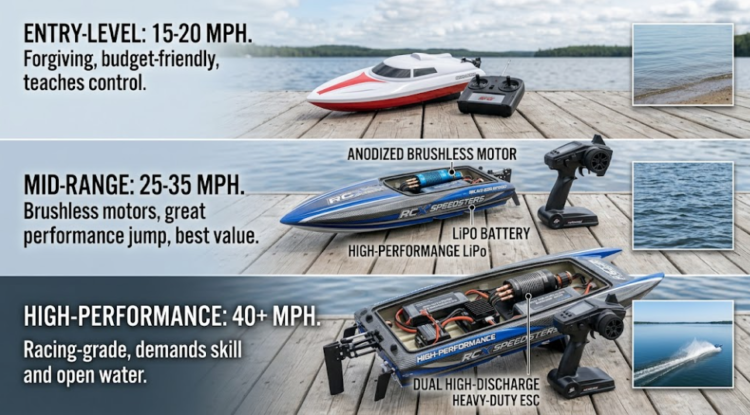
Boats in the entry-level range usually top out somewhere between 15 and 20 mph, and that’s honestly plenty for most people getting into the hobby. They’re forgiving, they’re cheap to repair if you flip one, and they teach you the basics of throttle control before you move up to something quicker.
Mid-Range Boats
Once you move into mid-range territory, brushless motors start showing up more consistently, and top speeds climb into the 25 to 35 mph range. This is where I’d personally recommend most people land if speed is genuinely the priority, since the jump in performance from entry-level is huge, but the price hasn’t gotten out of hand yet.
High-Performance Boats
At the top end, you’re looking at boats built specifically for racing, often hitting 40 mph and beyond. These aren’t really beginner-friendly. They demand a smooth, open body of water, a steady hand, and a willingness to occasionally lose a boat to a mechanical failure at full speed. I’d only point someone toward this tier once they’ve already put in the hours on something slower.
My Honest Take on Picking a Fast Boat
I don’t think everyone needs a race-grade hull that costs several hundred dollars. If you’re newer to the hobby and just want something quick and genuinely enjoyable without draining your wallet, I actually put together my full experience with a budget option here: Best RC Boat Under $100. I went in expecting it to be slow and flimsy, and it surprised me in a good way.
On the flip side, speed isn’t the only thing worth chasing in this hobby. If precision and control matter more to you than raw top speed, I wrote up what I learned picking my first slower, more controlled boat over here: Best RC Fishing Boat for Beginners. It taught me a lot about how hull design changes the way a boat behaves on the water, speed aside.
Mistakes That Quietly Kill Your Top Speed
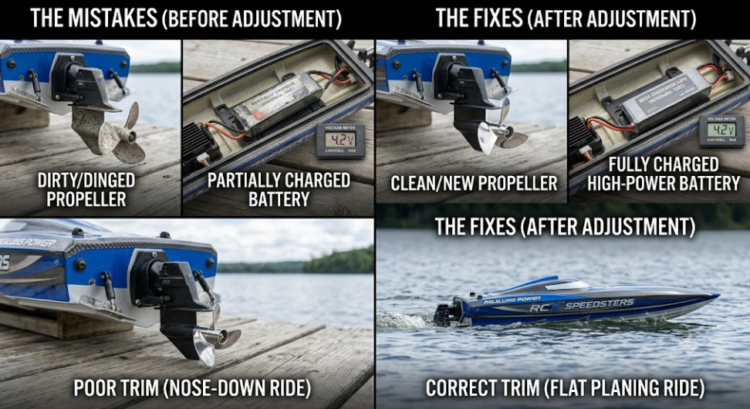
A dirty or dinged propeller will cost you more speed than people realize. So will running a battery that’s only partially charged, which sounds obvious but happens to almost everyone at some point. Water temperature plays a role too, since colder water is denser and adds a surprising amount of drag.
Trim matters more than people give it credit for as well. A boat that’s riding nose-down will fight the water instead of skimming over it, and a few small adjustments to the trim tabs can add real speed without touching the motor or battery at all. None of these are exciting fixes, but they’re the difference between a boat that feels fast and one that actually is.
A Few Things I Wish Someone Had Told Me Sooner
Run-time drops noticeably once you’re pushing a boat at full throttle for long stretches, so don’t judge a battery by its rated capacity alone. Also, cheaper propellers warp faster than you’d expect, especially after a few hard impacts with debris. Keeping a spare prop or two in your bag has saved more than one outing for me.
Water choice matters just as much as the boat itself. Slightly choppy water at a public lake will always slow you down compared to a still, private pond, and I’ve stopped comparing my own top-speed numbers between different locations because of it.
At the end of the day, the fastest RC boat for you depends on where you’re running it and what kind of water you’re dealing with. I also think it’s worth remembering that a slightly slower boat you can actually control is more fun, week after week, than a rocket you’re scared to open up. If you’re just starting out, don’t overthink it. Pick something solid, learn how it handles, and upgrade from there. That’s the path that worked for me, and I think it’s the one that’ll save you the most money and frustration in the long run.