
A few years ago, I made a mistake that most RC beginners make.
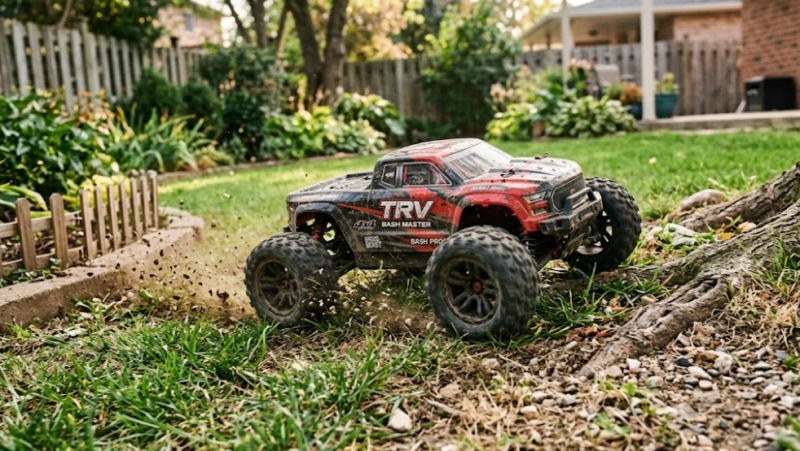
I bought an RC car based entirely on the speed number printed on the box. It looked fast, aggressive, and honestly pretty awesome. Ten minutes later it was stuck in my backyard grass, bouncing over tree roots, and struggling to get across terrain that didn’t look difficult at all.
That’s when I realized something important: the best RC car for backyard bashing isn’t necessarily the fastest one. It’s the one that can handle the kind of terrain most of us actually drive on.
What Backyard Bashing Really Means
If you’re new to the RC hobby, “backyard bashing” simply means driving your RC car for fun on whatever terrain happens to be available.
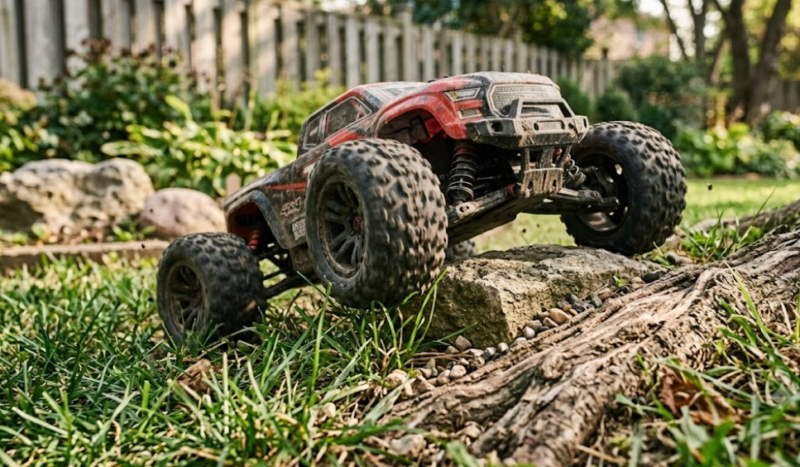
For most people, that means grass, dirt, gravel, uneven ground, tree roots, small hills, and random obstacles that seem to appear out of nowhere.
The funny thing is that many RC cars look capable online but feel completely different once they hit real backyard terrain.
I’ve owned cars that felt incredible on pavement but became nearly undrivable the moment they touched grass. I also think this is why so many beginners end up disappointed after their first purchase.
👉 Best Backyard RC Cars – Amazon Search
As an Amazon Associate I earn from qualifying purchases.
Why Grass Is the Ultimate RC Car Test
Grass Is Harder Than It Looks
Most people underestimate how difficult grass can be.
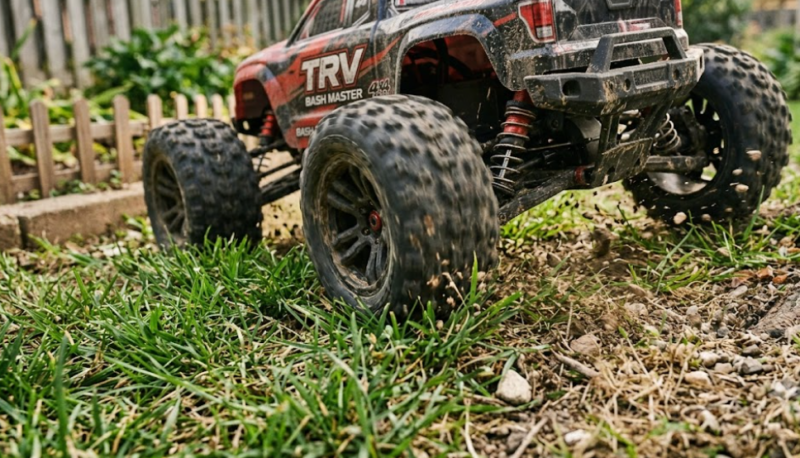
Even a well-maintained lawn creates a surprising amount of rolling resistance. The motor works harder, batteries drain faster, and smaller vehicles quickly lose momentum.
I learned this lesson the hard way.
One of my first RC cars could hit impressive speeds on asphalt. In my backyard? It moved like it was towing a trailer.
That’s why tire size and ground clearance matter so much.
Larger tires help the vehicle stay on top of the terrain instead of constantly fighting through it.
Ground Clearance Makes a Huge Difference
Ground clearance isn’t the most exciting specification, but it’s one of the most important.
A car with enough clearance can drive over roots, rocks, and uneven patches without scraping the chassis every few feet.
In my opinion, I’d rather have an RC car with slightly less speed and more ground clearance than the other way around.
For backyard driving, capability beats top speed almost every time.
If you’re still learning how different RC vehicle designs affect performance, I recommend reading my guide on RC car types and how they handle different terrain:
Understanding the difference between on-road and off-road platforms can save you from buying the wrong vehicle in the first place.

Four-Wheel Drive Is Worth It
Why 4WD Feels Better in Real Conditions
When people ask me for a backyard RC recommendation, one feature always ends up near the top of the list: four-wheel drive.
Grass, loose dirt, and uneven surfaces constantly challenge traction.
A 4WD setup helps distribute power more effectively and gives the vehicle a much more confident feel.
Can a two-wheel-drive RC car work?
Absolutely.
But if your goal is hassle-free backyard fun, I also believe 4WD is one of the easiest ways to improve the overall driving experience.
The extra traction becomes noticeable almost immediately.
Bigger Isn’t Always Better, But It Usually Helps
One thing I wish I had understood earlier is RC scale size.
When I first entered the hobby, I focused entirely on speed ratings and ignored scale size completely.
That turned out to be a mistake.
Larger RC cars generally handle backyard terrain more effectively because they have bigger tires, more suspension travel, and better obstacle clearance.
If you’re unsure whether a 1/10, 1/8, or smaller model makes sense for your situation, I recently put together a complete guide explaining RC scale sizes and what they actually mean in real-world use:
It’s one of those topics that seems boring until you buy the wrong size and start regretting it.
Durability Matters More Than Speed
Here’s something I didn’t understand when I first got into RC cars.
Crashing is part of the hobby.
Nobody plans to hit a tree, launch off a bump unexpectedly, or clip a garden border. It just happens.
A lot.
That’s why durability should be one of your top priorities.
Strong suspension arms, quality shocks, reliable drivetrains, and readily available replacement parts matter far more than a flashy top-speed claim.
I also think many beginners spend too much time chasing speed and not enough time considering repair costs.
The fastest RC car in the world isn’t much fun if it’s constantly sitting on your workbench waiting for parts.

Electric vs Nitro for Backyard Fun
For most backyard drivers, electric RC cars make the most sense.
They’re quieter, easier to maintain, and much simpler to operate.
Charge the battery, plug it in, and start driving.
Nitro models definitely have their fans, but they require more maintenance and tuning than most casual hobbyists want to deal with.
Personally, I enjoy spending my weekends driving RC cars, not adjusting engines.
That’s why electric platforms remain my first recommendation for backyard use.
The Biggest Mistake Beginners Make
The most common mistake I see is focusing exclusively on speed.
Manufacturers know speed sells.
It’s easy to get excited about a vehicle capable of 50, 60, or even 70 mph.
But backyard terrain doesn’t care about marketing numbers.
What matters is traction, suspension, durability, and how well the vehicle handles real-world obstacles.
Some of the most enjoyable RC cars I’ve ever owned weren’t the fastest.
They were simply the ones that worked every time I took them outside.
After years of driving RC cars in backyards, parks, dirt fields, and pretty much anywhere I could legally run them, I’ve come to one simple conclusion.
The best RC car for backyard bashing isn’t the fastest, the most expensive, or the one with the most impressive specifications.
It’s the one that can handle grass, dirt, uneven terrain, and unexpected obstacles without turning every driving session into a repair project.
In my opinion, a durable off-road platform with good ground clearance, capable suspension, and four-wheel drive will provide far more enjoyment than a speed-focused machine designed primarily for smooth pavement.
And honestly, that’s what backyard bashing is all about—less time worrying about specs and more time having fun.