How Do RC Cars Work? Explained for Beginners
At first glance, RC cars look almost too simple. A small car. A controller. You pull a trigger, the car moves. Easy, right?
But then something doesn’t work. The car won’t turn. It stops randomly. The battery feels warm. Suddenly, what looked like a toy feels like a tiny engineering project. This is usually the moment beginners either give up—or finally decide to understand how RC cars actually work.
This guide is for the second group.
No sales talk. No brand pushing. Just a clear explanation of how RC cars work, written for people who want answers without a headache.
The Basic Idea Behind RC Cars
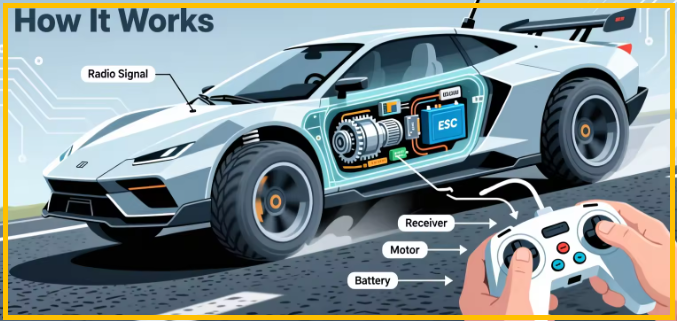
An RC car works by receiving radio signals from a handheld controller and converting those signals into physical movement.
That’s it. Everything else is just support systems.
You control the car remotely. The car listens. The electronics translate your input into motion.
The Signal Flow: From Your Hands to the Wheels
Step 1: Controller Input
When you pull the trigger or turn the steering wheel on your transmitter, you’re not directly controlling the motor. You’re sending instructions.
Step 2: Radio Signal Transmission
The transmitter sends a radio signal—usually in the 2.4GHz range—to the car. This signal carries information like speed, direction, and braking.
Step 3: Receiver Interpretation
Inside the RC car, the receiver listens only to your controller. It filters out other signals and converts your input into electronic commands.
Step 4: Electronic Speed Controller (ESC) Response
The ESC takes those commands and decides how much power to send to the motor. More trigger pressure equals more power.
Step 5: Motor and Steering Action
The motor spins. The wheels turn. Steering servos adjust direction. The car moves.
If one part of this chain fails, the car doesn’t work correctly—or at all.
Key Components That Make RC Cars Work
Transmitter (Remote Controller)
This is your control hub. Modern transmitters use digital signals, which are more reliable than older analog systems.
Receiver
The receiver acts like a translator. Without it, your RC car is just a battery-powered brick.
Electronic Speed Controller (ESC)
Think of the ESC as a power manager. It protects the motor while delivering smooth acceleration.
Motor
RC motors convert electrical energy into mechanical motion. Brushless motors are more efficient, but brushed motors are easier for beginners to understand.
Battery
The battery supplies energy to everything. Battery condition directly affects performance, responsiveness, and runtime.
Basic explanations of RC car components are also covered in beginner-friendly posts on
👉 Redcat Racing Parts Guide
Why RC Cars Sometimes Don’t Respond Correctly
When beginners ask why their RC car behaves strangely, the answer is usually not “bad luck.”
Common causes include:
- Weak or unbalanced batteries
- Loose connectors
- Receiver signal interference
- ESC calibration issues
Understanding how RC cars work makes troubleshooting much easier. General troubleshooting concepts are explained further at
👉 Redcat Racing for Beginners
How Steering Works in RC Cars
Steering is controlled by a servo motor. When you turn the wheel on the transmitter, the receiver sends a signal to the servo, which physically moves the steering linkage.
If steering feels off, it’s usually a mechanical alignment issue—not an electronic failure.
How Speed Control Works
Throttle control isn’t just “on” or “off.”
The ESC regulates power flow in small increments, allowing smooth acceleration. This prevents sudden stress on gears and drivetrain components.
Speed behavior often changes as batteries age, which is why consistent performance requires basic maintenance.
Do RC Cars Think for Themselves?
No—and that’s important.
RC cars do not make decisions. They react. If something goes wrong, it’s usually a mechanical or electrical issue, not software logic.
That’s good news for beginners. Problems are usually visible and fixable.
Are RC Cars Complicated to Maintain?
Not really. They just require consistency.
Simple habits like cleaning, inspecting connectors, and storing batteries properly prevent most issues. You’ll find general maintenance principles explained clearly across multiple RC-related posts on
👉 What Is an RC Car? A Beginner’s Guide
Why Learning How RC Cars Work Matters
Understanding how RC cars work helps you:
- Avoid unnecessary repairs
- Diagnose problems faster
- Drive more confidently
- Enjoy the hobby long-term
Most people who quit RC cars do so because they never learned the basics.
Frequently Asked Questions (FAQ)
How do RC cars communicate with controllers?
They use radio signals sent from the transmitter to the receiver inside the car.
Do RC cars use Wi-Fi or Bluetooth?
Most hobby-grade RC cars use dedicated radio frequencies, not Wi-Fi.
What happens if the signal is lost?
Many RC cars stop automatically to prevent damage.
Is learning RC car electronics hard?
No. Once you understand signal flow, everything becomes logical.
Can beginners understand RC car mechanics?
Yes. RC cars are designed to be modular and repairable.
RC cars aren’t mysterious machines. They’re simple systems working together—signals, power, and motion.
Once you understand how RC cars work, problems feel less frustrating and the hobby becomes far more enjoyable.
And honestly? That’s when the fun really starts.