
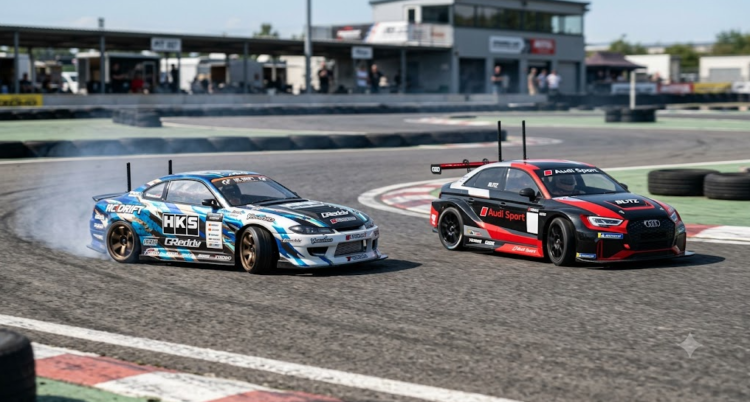
RC Drift vs Touring Car – Which One Is More Fun?
A few years back, I honestly thought every on-road RC car was basically the same. If it had four wheels, a brushless motor, and looked fast, I figured I’d have a good time. After spending weekends with both drift cars and touring cars, I realized they’re built for completely different kinds of fun—and I wish someone had explained that before I bought my first one.
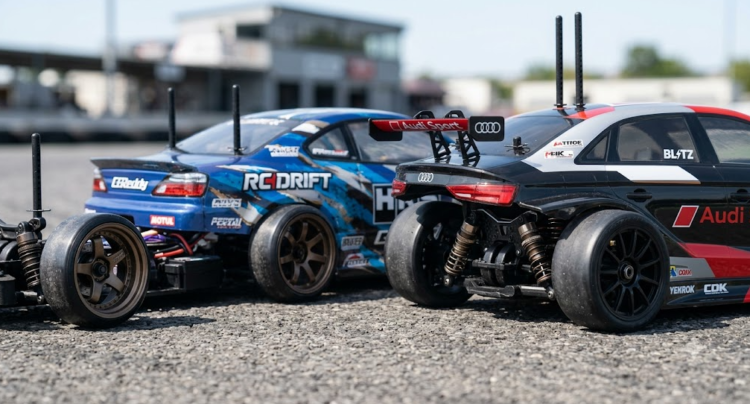
RC Drift vs Touring Car – What’s the Real Difference?
At first glance, it’s easy to assume these cars are almost identical. They’re both low to the ground, both designed for pavement, and both can be surprisingly quick with modern electronics.
But the similarities pretty much end the second you squeeze the trigger.
A touring car is all about grip. Everything from the suspension geometry to the tires is designed to keep the car planted through corners while carrying as much speed as possible. Every lap becomes a challenge to brake a little later, hit a cleaner racing line, and shave a few tenths off your previous time.
A drift car, on the other hand, is built with an entirely different goal in mind.
Instead of maximizing traction, you’re intentionally reducing it. The rear tires are meant to slide, and your job is to control that slide with smooth steering and throttle inputs. You’re not trying to finish first. You’re trying to make every corner look effortless.
I used to think drifting would actually be easier because the cars weren’t chasing maximum grip. Turns out, I couldn’t have been more wrong. Holding a clean drift through an entire corner takes a surprising amount of coordination, and it gave me a whole new appreciation for people who make it look easy.
👉 RC Drift vs Touring Car – Which One Is More Fun?
As an Amazon Associate I earn from qualifying purchases.
Driving Experience
Touring Cars Feel Fast in Every Corner
The first properly set up touring car I drove completely changed my expectations.
The steering felt razor sharp.
Every tiny movement of the wheel produced an immediate response, and the car almost seemed glued to the pavement. It rewarded smooth driving instead of aggressive inputs, and every lap taught me something new.
What surprised me most wasn’t the speed.
It was how satisfying it felt to improve little by little.
One lap I’d brake too late.
The next lap I’d carry just a little more speed through the corner.
Before long, I found myself chasing consistency instead of top speed.
If you’re naturally competitive or enjoy improving your own skills, a touring car has a way of keeping you hooked without ever feeling repetitive.
Drift Cars Feel More Like an Art Form
My first drift session was honestly a disaster.
I spun out.
I overcorrected.
I hit imaginary walls that didn’t even exist.
For a while, I wondered why anyone enjoyed drifting at all.
Then something clicked.
Instead of fighting the slide, I learned to work with it.
That’s the moment drifting became incredibly addictive.
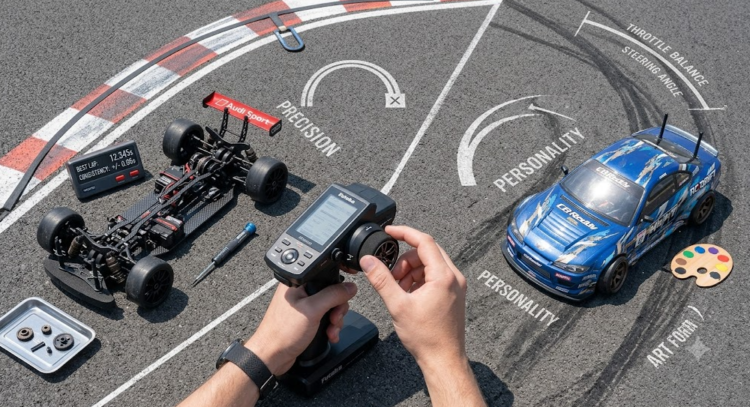
Unlike racing, where you’re trying to be as efficient as possible, drifting is all about rhythm. Every corner becomes a balancing act between throttle, steering angle, and timing. When everything comes together, the car flows through a corner in a way that’s surprisingly satisfying.
I also realized something unexpected.
Drifting doesn’t feel stressful.
Even though you’re constantly making steering corrections, it almost feels relaxing. You’re not staring at a stopwatch or worrying about lap records. You’re simply trying to link one smooth corner into the next, and somehow that becomes incredibly rewarding.
There’s also a creative side to drifting that I didn’t appreciate until I spent more time with it. Different lines, different angles, different transitions—everyone develops their own style. Two people can drive the exact same chassis and make it look completely different.
That’s something touring cars don’t really offer.
One is about precision.
The other is about personality.
Neither approach is better.
They’re just built for different kinds of drivers, and I honestly think that’s why so many RC enthusiasts eventually end up owning both.
Which One Is Easier for Beginners?
Touring Cars Have a Shorter Learning Curve
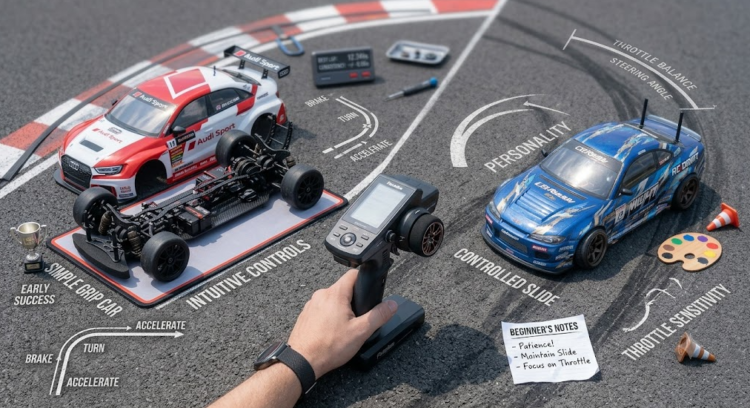
Most beginners naturally understand how a touring car should behave.
Turn the wheel.
Brake before corners.
Accelerate when exiting.
The car behaves much like a full-size performance vehicle, making the learning process fairly intuitive.
If you’re introducing someone completely new to the hobby, I also think touring cars are easier to recommend because early success builds confidence.
Drift Cars Require Patience
Drifting asks your brain to rethink everything.
Instead of correcting a slide immediately, you’re often maintaining it.
Throttle control becomes just as important as steering.
Many new drivers spend their first few batteries spinning in circles.
That’s perfectly normal.
Once the muscle memory develops, however, drifting becomes incredibly satisfying.
Maintenance Differences
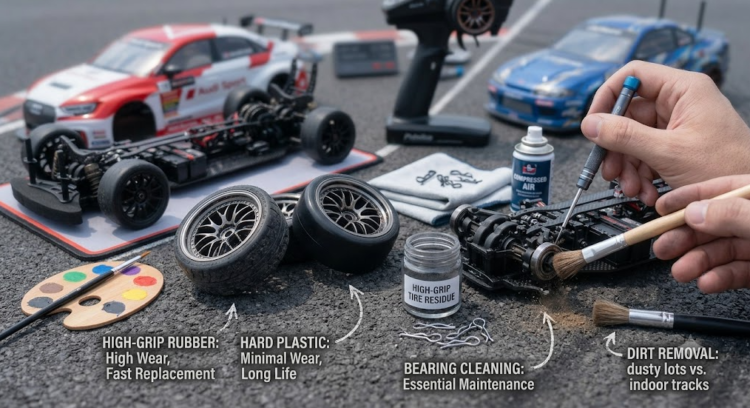
Both platforms share many components including motors, ESCs, servos, and batteries.
The biggest difference comes from tire wear.
Touring car tires are made from high-grip rubber, especially if you’re driving on prepared tracks.
Drift cars usually use hard plastic tires that can last much longer depending on the surface.
That surprised me.
I expected drifting to destroy tires quickly, but plastic drift tires often survive dozens of sessions with very little wear.
Touring cars, especially powerful brushless setups, may require replacing tires much more frequently.
Maintenance also depends heavily on where you drive.
Dusty parking lots introduce dirt into bearings and suspension components, while indoor tracks generally keep maintenance simpler.
I also recommend cleaning either platform after every few runs. It only takes a few minutes and can noticeably extend the life of your electronics and drivetrain.
Which One Costs More?
The answer depends on how deep you plan to go.
Entry-level RTR touring cars and drift cars often cost about the same.
Where expenses begin to separate is upgrades.
Touring enthusiasts frequently invest in higher-grip tires, precision shocks, lightweight chassis parts, and race electronics.
Drift enthusiasts often customize appearance just as much as performance.
Bodies, wheels, lighting kits, magnetic body mounts, scale accessories, and detailed interiors become part of the hobby.
I’ve seen drift cars that look almost identical to real street cars.
Some builders spend weeks perfecting tiny visual details that most people would never notice.
Honestly, that’s part of the fun.
Where Can You Drive Each One?
Touring Cars
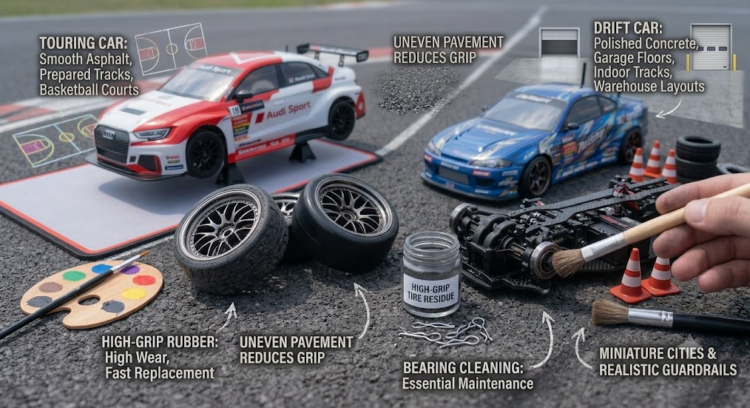
Touring cars work best on smooth asphalt, prepared tracks, basketball courts, or large parking lots.
The smoother the surface, the better the handling.
Uneven pavement quickly reduces grip and makes driving less enjoyable.
Drift Cars
Drift cars shine almost anywhere with a smooth surface.
Polished concrete.
Garage floors.
Indoor drift tracks.
Warehouse-style layouts.
Some enthusiasts even build miniature cities complete with curbs, painted parking spaces, tunnels, and realistic guardrails.
Watching several drift cars run together almost feels like watching scaled-down motorsports.
Which One Keeps You Interested Longer?
This surprised me more than anything else.
I expected the faster touring car to hold my attention longer.
Instead, both offered completely different reasons to keep coming back.
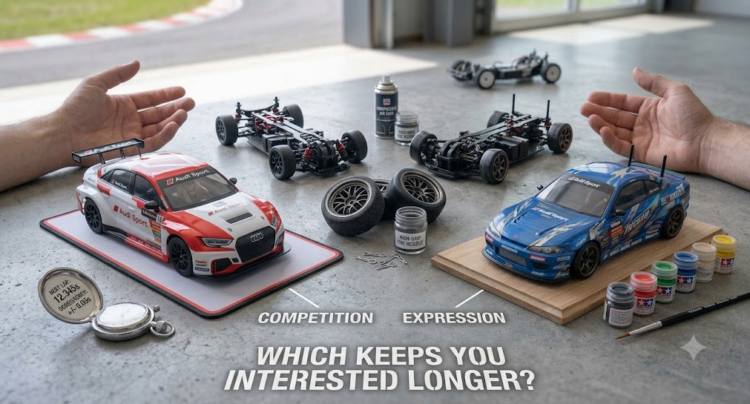
Touring cars constantly challenged me to improve my lap times.
Drift cars challenged me to improve my style.
Neither became boring because the goals were completely different.
I also believe this explains why so many experienced hobbyists eventually own both.
One scratches the competitive itch.
The other satisfies creativity.
If you’re just getting started, you might also enjoy reading my guide on How Fast Should Your First RC Car Be?, where I explain why beginners often buy cars that are much faster than they actually need. It helped me set realistic expectations before upgrading.
Another article worth checking out is Best RC Rally Car – 9 Picks That Make Every Dirt Road More Fun. Rally cars sit somewhere between on-road racing and loose-surface driving, making them a fantastic option if you want versatility without choosing only one style.
So Which Should You Buy?
There’s no universal winner.
If your idea of fun involves shaving tenths of a second off every lap, improving racing lines, and chasing precision, a touring car is probably the better choice.
If you enjoy creativity, realistic driving, stylish cornering, and learning new techniques over time, drifting delivers a completely different kind of satisfaction.
I also came to realize that choosing between them isn’t really about speed.
It’s about personality.
Some people enjoy competition.
Others enjoy expression.
Both are rewarding.
Both can become lifelong hobbies.
And if you’re anything like me, you’ll probably convince yourself you only need one… right before buying the other a few months later.