How Fast Should Your First RC Car Be? Here’s What I Wish Someone Had Told Me
The first RC car I ever bought was way faster than I was ready for. I thought more speed meant more fun, but after hitting a curb in less than five minutes, I realized I’d fallen for the marketing instead of thinking about how I’d actually use it. Looking back, I would’ve enjoyed the hobby much sooner if I’d started with something easier to control.
Why Everyone Obsesses Over Speed
If you’ve been shopping for your first RC car, you’ve probably noticed one thing: every product page seems to brag about top speed.
“40 MPH.”
“50 MPH.”
“60+ MPH.”
It almost makes you feel like buying anything slower would be a mistake.
I thought the exact same thing.
The funny part is that after spending more weekends driving RC cars, I almost stopped paying attention to those numbers altogether. They look impressive on the box, but once you’re actually behind the controller, speed becomes only one small part of the experience.
What really matters is whether you can confidently drive the car, enjoy it for an entire battery pack, and head home smiling instead of searching online for replacement parts.
If you’re completely new to the hobby, I’d recommend reading my guide on What Is an RC Car? A Beginner’s Guide to How RC Cars Really Work first. It explains the basics without all the confusing hobby jargon and makes everything else much easier to understand. What Is an RC Car? A Beginner’s Guide to How RC Cars Really Work
The Biggest Mistake I Made as a Beginner
My first instinct was simple.
Buy the fastest RC car I could afford.
That lasted about one afternoon.
Every little squeeze of the throttle launched the car farther than I expected. Instead of learning smooth steering, I spent most of my time trying not to crash. Every corner felt rushed, every straightaway ended too quickly, and honestly, I was more nervous than excited.
I also realized something that experienced hobbyists rarely mention.
Driving an RC car isn’t just about making it go fast.
It’s about making it go exactly where you want.
Those are two very different skills.
👉 How Fast Should Your First RC Car Be?
As an Amazon Associate I earn from qualifying purchases.
The Speed Sweet Spot for Most Beginners
If a friend asked me today what speed they should look for in their first RC car, my answer would be much different than it would’ve been years ago.
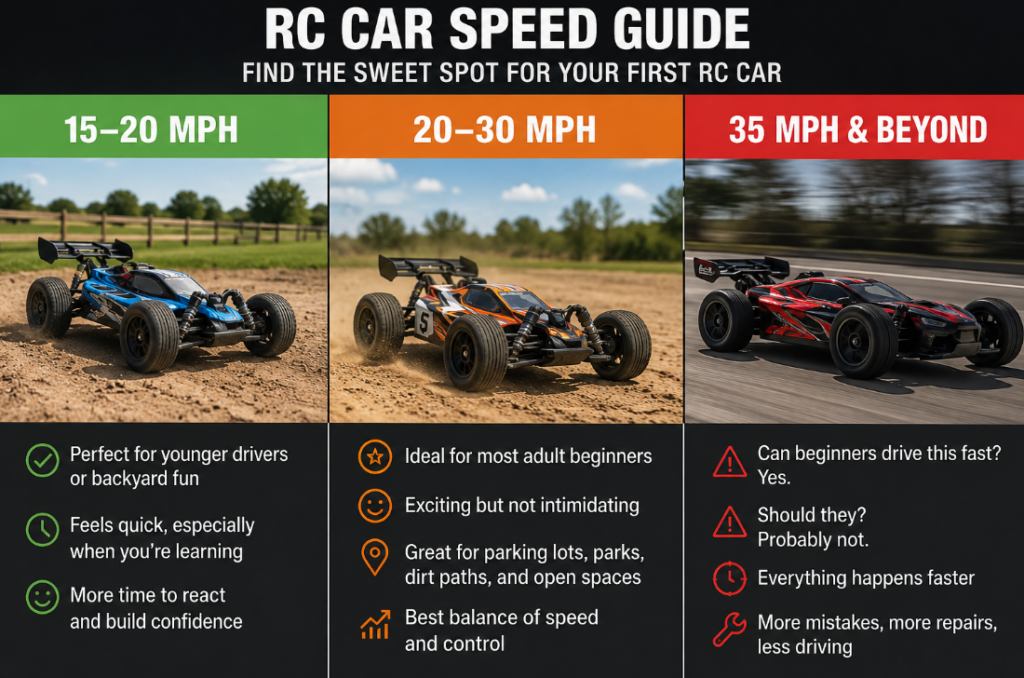
Around 15–20 MPH
This is perfect if you’re buying an RC car for younger drivers or simply want something relaxing to drive around the backyard.
It still feels surprisingly quick, especially when you’re learning.
More importantly, it gives you enough time to react.
Around 20–30 MPH
This is the range I’d recommend to almost every adult getting into the hobby.
It feels exciting without feeling intimidating.
You’ll have enough speed to enjoy parking lots, parks, dirt paths, and open spaces while still having enough control to improve your driving skills naturally.
Even now, I think this is the range where RC driving is the most enjoyable.
35 MPH and Beyond
Can beginners drive something this fast?
Sure.
Should they?
Probably not.
At these speeds, everything happens faster than you expect.
Mistakes become expensive.
Reaction time becomes critical.
And you’ll spend more time fixing than driving.
There’s absolutely nothing wrong with owning a fast RC car—I love them now—but I don’t think they’re the best teachers.
Where You Drive Changes Everything
One thing I completely ignored when shopping was where I’d actually be driving.
That turned out to matter almost as much as speed itself.
A small backyard doesn’t need a 50 MPH RC car.
Neither does a neighborhood cul-de-sac.
On the other hand, a large dirt field suddenly makes moderate speeds feel just right because you have room to relax and enjoy the drive.
I’ve also noticed something interesting over the years.
An RC car with excellent handling often feels faster than one with a higher advertised top speed because you’re actually comfortable keeping the throttle open.
Confidence makes everything feel quicker.
Don’t Ignore the Battery
This surprised me more than anything else.
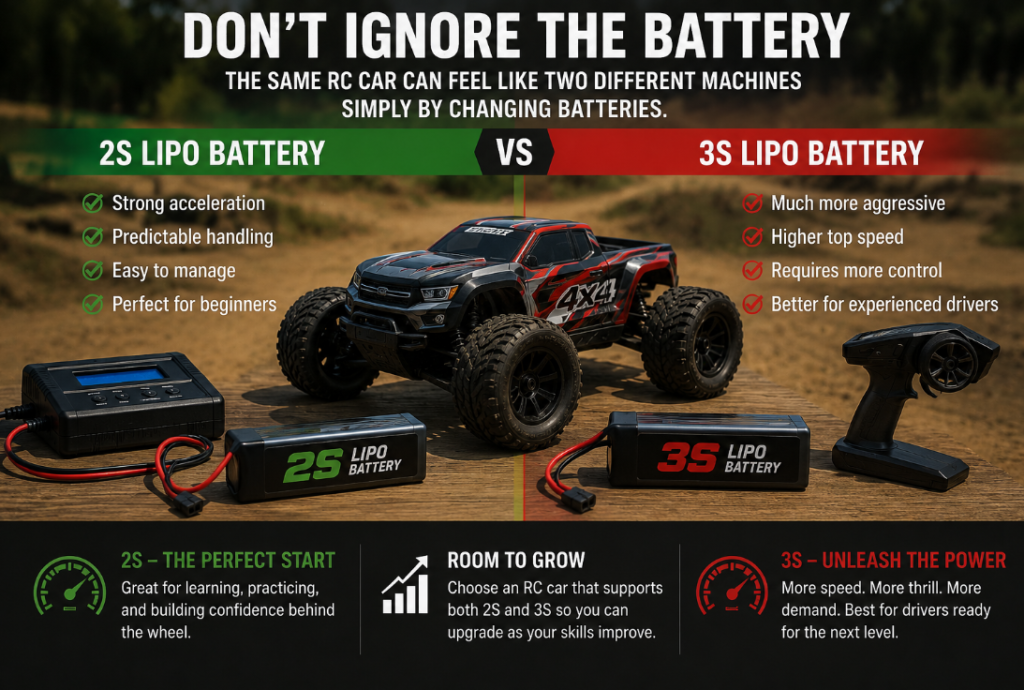
The exact same RC car can feel like two completely different machines simply by changing batteries.
Most beginner-friendly models run beautifully on a 2S LiPo battery.
Acceleration feels strong.
Handling stays predictable.
Everything remains easy to manage.
Switching to a 3S battery suddenly changes the personality of the vehicle.
Acceleration becomes much more aggressive.
Top speed jumps noticeably.
That’s fantastic once you’ve built experience, but it can overwhelm someone who’s still figuring out basic throttle control.
Buying an RC car that supports both battery types gives you room to grow without replacing the entire vehicle later.
Things That Matter More Than Speed
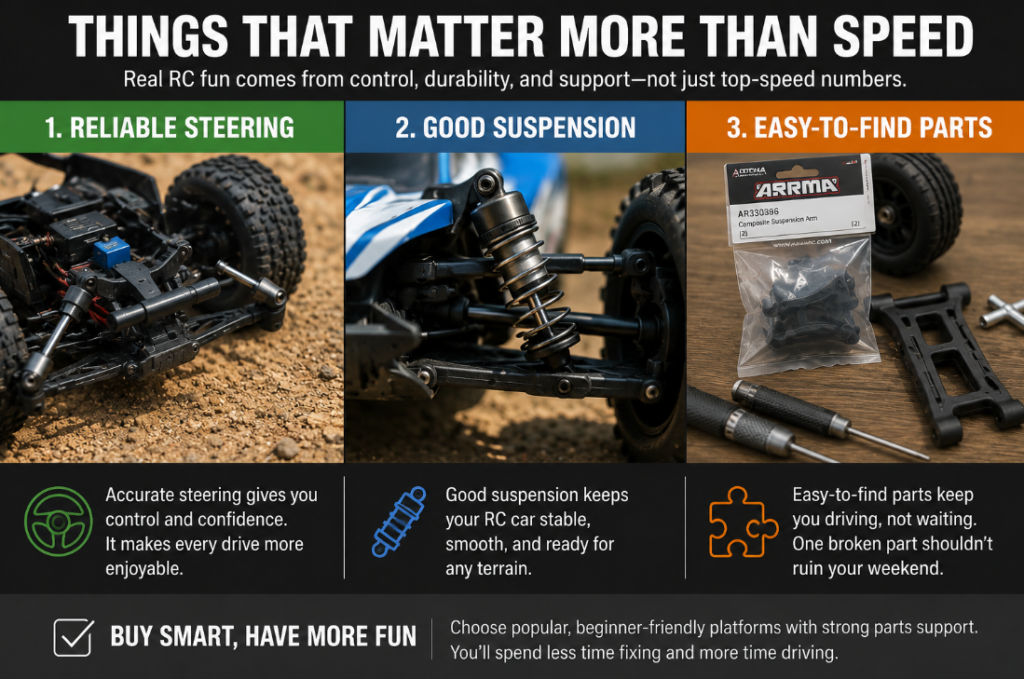
When I look back at every RC car I’ve enjoyed over the years, speed rarely sits at the top of the list.
Reliable steering matters more.
Good suspension matters more.
Easy-to-find replacement parts matter much more than most beginners realize.
One broken suspension arm shouldn’t end your weekend because you can’t find parts.
That’s one reason I always recommend buying popular beginner platforms with strong parts support.
You’ll thank yourself later.
Think Beyond Day One
Here’s something I wish someone had told me much earlier.
Your first RC car probably won’t stay exactly the way you bought it.
Eventually you’ll want better tires.
A stronger battery.
New shocks.
Maybe a brushless setup later.
That’s completely normal.
Instead of buying the absolute fastest model available today, buy one that you’ll still enjoy upgrading six months from now.
If you’re still deciding what size RC car fits your lifestyle, storage space, and driving area, my guide on RC Car Scale Sizes Explained (1/10, 1/8, etc.) can help you avoid another beginner mistake that I made myself. RC Car Scale Sizes Explained (1/10, 1/8, etc.)
My Honest Advice
If I could go back and buy my very first RC car again, I wouldn’t chase the highest speed number anymore.
I’d choose something around 25 MPH.
I’d spend more time learning smooth throttle control.
I’d drive more and repair less.
And I’d probably fall in love with the hobby even faster than I did.
Looking back, I still think starting with a manageable RC car was the best lesson I eventually learned. Speed is exciting, but confidence is what keeps you coming back every weekend. Once your skills catch up, faster RC cars will always be there waiting. Until then, focus on enjoying the drive instead of chasing numbers. Trust me—your future self (and your wallet) will appreciate it.