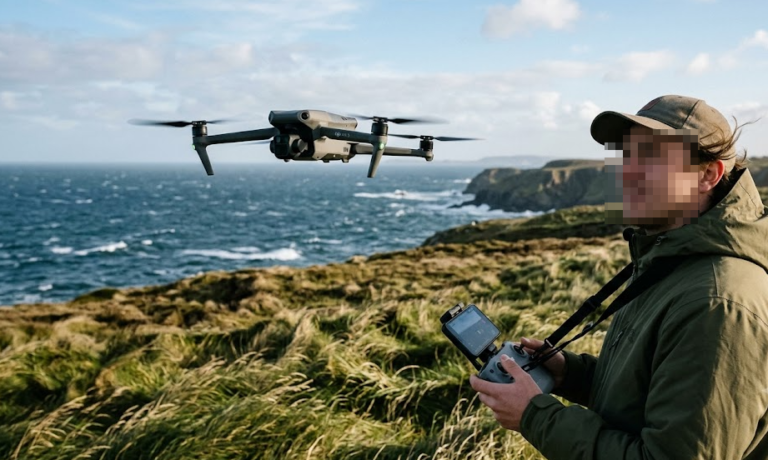

Why Did Drones Fall Skywalker Range? What Usually Happens
Why did drones fall Skywalker range even when the pilot was still well inside the advertised distance? It sounds strange at first, but this kind of thing happens more often than you’d think. A Skywalker X8 or X6 can be flying normally one minute and suddenly start losing control the next.
In many cases, the aircraft itself isn’t the problem. The bigger issue is that radio range doesn’t work quite like the number printed on the transmitter box suggests. It’s easy to look at the range number on a transmitter and think of it as a fixed limit. If the radio says 5 km, you naturally assume 4 km should be safe.
But radio range doesn’t really work that way. The signal gradually gets weaker as the aircraft moves farther away. Eventually, the receiver starts missing packets, and that’s when things can get interesting very quickly. What happens next depends on the receiver and failsafe setup. The aircraft might trigger a failsafe, return home, cut the motor, or simply keep following the last command for a moment. That last situation can be especially confusing because, from the ground, it can look like the plane simply decided to fall out of the sky.
I’ve seen this kind of problem cause a lot of confusion. The pilot is watching the aircraft the whole time, so when it suddenly stops responding, the first thought is usually, “I must have gone too far.”
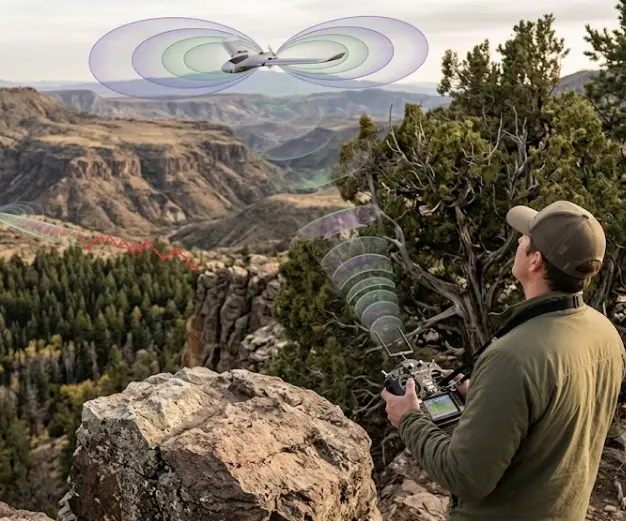
Altitude Can Change Your Range More Than You Think
This is where Skywalker pilots can get caught out. These wings are often flown high and far, which makes antenna orientation more important than it might seem. A typical dipole antenna doesn’t radiate equally in every direction. There can be weaker areas above and below the antenna, so the aircraft’s position relative to the transmitter can matter just as much as the distance itself.
The same thing can happen with terrain. A hill, trees, or even a building between you and the aircraft can weaken the signal surprisingly quickly. A range test done over an open field won’t necessarily tell you what will happen at your usual flying spot.
It Isn’t Always the Radio
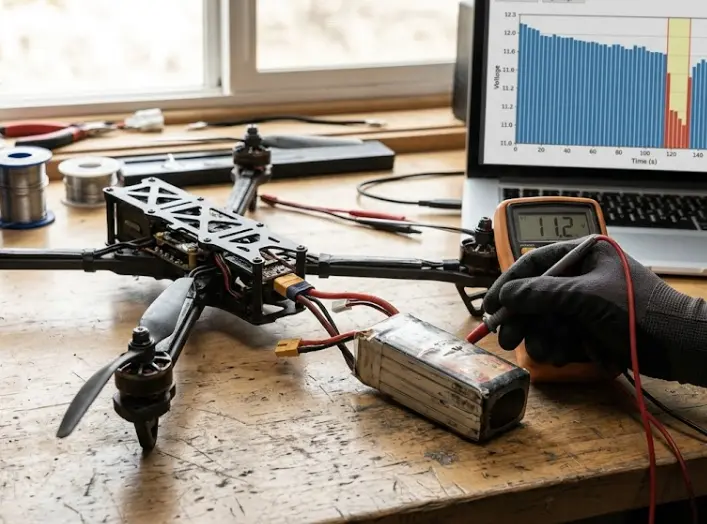
And sometimes, what looks like a range problem isn’t a range problem at all. As a LiPo pack sags under load, especially an older or undersized pack pushed hard on a long flight, the receiver can brown out for a split second. The plane loses control response, not because the signal dropped, but because the electronics briefly lost stable power. From the ground, that looks identical to a range failsafe.
If your flight controller records logs, check them before blaming the radio. A quick brownout can look very similar to a signal-loss problem from the ground. It’s worth checking the battery and power system before buying a longer-range radio.
Further Reading:
👉 Why Do Drones Suddenly Fall? 6 Common Reasons Every Pilot Should Know
What Actually Helps
Start with the antennas. If your receiver has two antennas, don’t simply mount them side by side in exactly the same direction. Giving them some separation or changing their orientation can help reduce weak spots.
A diversity receiver can also help. With two antennas, the receiver can use the stronger signal instead of relying on a single antenna position.
Then check the failsafe. Decide what you want the aircraft to do when the radio link disappears. A controlled glide or RTH is obviously preferable to leaving the aircraft on its last throttle command.
Of course, not every Skywalker signal loss comes down to antenna placement or battery condition. A bad receiver, damaged antenna, faulty transmitter module, or another hardware problem can cause the same symptoms. So before blaming the advertised range, check the simple things first: antenna orientation, battery condition, receiver power, and failsafe settings. Those checks can often tell you much more than the range number on the box.