RC Car Gearbox Noise: Check These Things Before Buying New Gears
RC car gearbox noise sends the mind straight to worn gears, but it doesn’t always mean the teeth are worn out. A slightly bad gear mesh, a loose screw, some dirt, or old grease can make a perfectly good drivetrain sound much worse than it actually is. Many of these checks only take a hex driver and a few minutes, so there’s no reason to buy new parts right away.
Start With the Sound Itself
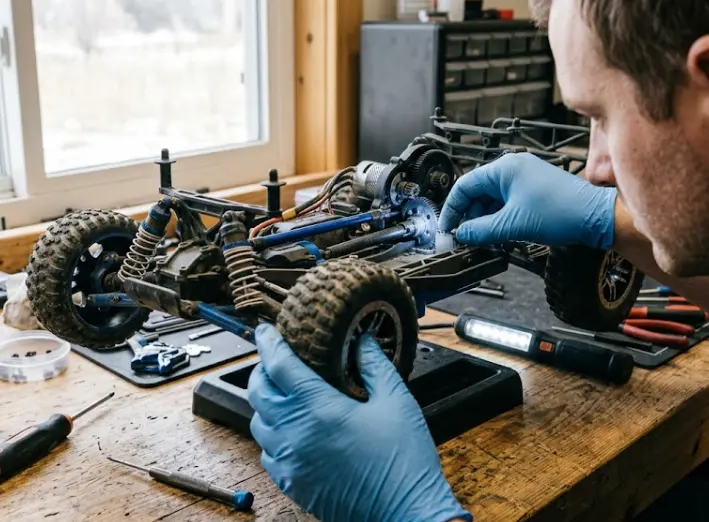
The first thing I’d pay attention to is when the noise happens. A whine that changes with the throttle is different from a click that comes around once per wheel rotation. A throttle-related whine makes me look at the pinion and spur gear first. If there’s a steady tick while the car is rolling, I’d check for debris or a rough spot in the drivetrain. A rattle over bumps, or while sitting at idle, is more likely to be something loose.
With the power off, put the car on a stand and slowly turn one of the wheels by hand. You’ll often feel a rough or tight spot through your fingers before you can really hear what’s wrong. After that, give it a little throttle while it’s still on the stand and listen again. If the noise goes away with the wheels off the ground, don’t assume the gearbox is the problem. It could be coming from somewhere else under load.
Gear Mesh Comes First
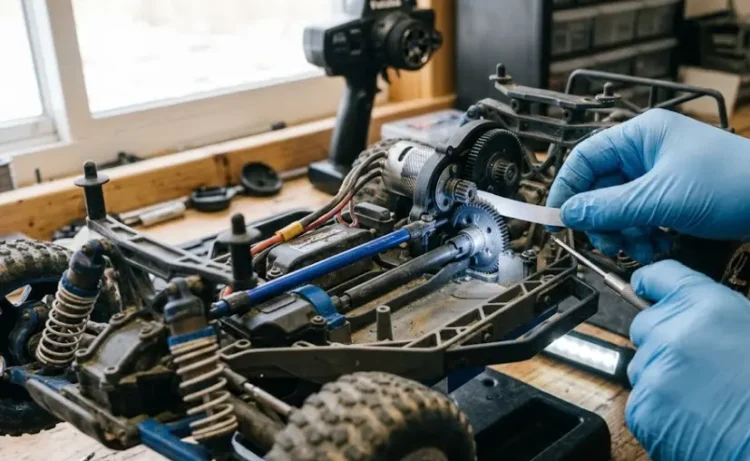
If I were checking one thing first, I’d start with the mesh between the pinion and spur gear. When the mesh is too tight, the gears can whine and put extra load on the motor. Too much play can cause rattling or ticking, and the gear teeth may wear faster if the mesh is badly off.
The paper test is still a simple way to get the mesh close on gearboxes that allow adjustment. Loosen the motor mount screws, place a thin strip of regular paper between the pinion and spur, and move the motor into position. Hold it there while you tighten the screws, then pull the paper out. With the paper gone, check that the spur gear has a little movement without feeling loose. Turn it back and forth by hand to check the play. The manual’s spec beats any paper thickness, so go by that if it gives one.
This won’t work on every RC car. Some gearboxes use a fixed motor position, so there’s no mesh adjustment to make. Check the manual first if you’re not sure how the motor is mounted.
Loose Screws, Grit, and Dry Grease
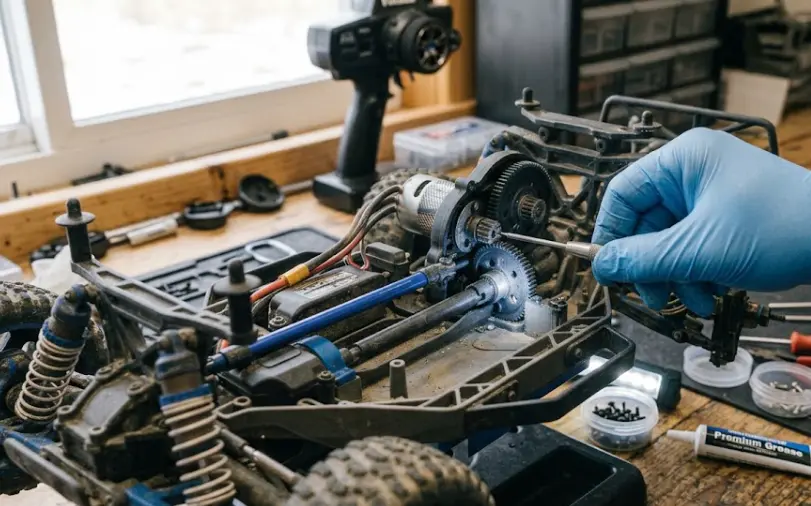
I’d also check the pinion set screw. If it’s coming loose, the pinion can move on the motor shaft and make a grinding noise that sounds like a bad gear. Give the motor mount screws and gearbox case screws a quick check while you have the driver out. Don’t crank down on the case screws, since too much pressure can make the gears bind.
Dirt is another thing to look for. Even a little sand inside the gearbox can create a surprisingly annoying noise, and it may start wearing the gears if it stays in there. If you open the gearbox, clean out the dirt you can find and inspect the teeth under a good light. The right grease can make a noticeable difference, but the grease that works for one type of gear may not be right for another. Check the manufacturer’s recommendation before adding anything, and don’t pack the gearbox full, because extra grease can make a mess and may attract dirt.
If your RC has a slipper clutch, listen for chatter or squealing when you accelerate hard. A setting that’s too loose can be one possible cause. Make small adjustments and test the car after each one, since the slipper setting affects how power reaches the wheels.
When It Isn’t the Gearbox
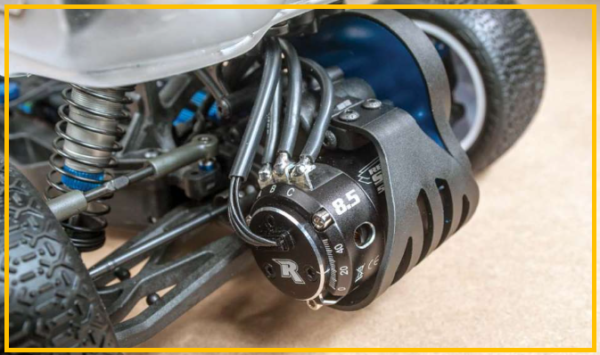
Sometimes the motor is making the noise, not the gearbox. The two sit close together, so it’s easy to blame the wrong part. If the sound seems to be coming from the motor itself, I covered that problem separately in RC car motor making a grinding noise.
Bearings are worth checking before ordering replacements. A dirty bearing may be the source of the noise, though whether it can be cleaned and reused depends on its condition and type. A loose wheel nut or a misaligned dogbone can also make the drivetrain sound like it has a gearbox problem.
If you’ve checked the basics and the noise is still there, take a closer look at the gear teeth with a flashlight. Look for chipped teeth, unusual wear, or teeth that have started to look hooked. If you find obvious damage, replacing the affected parts may be the next step.
Until you know what’s actually making the noise, I’d hold off on buying parts.