RC Car Steering Glitching When Throttle Pulled: What to Check and Fix
If your RC car’s steering twitches or jerks the moment you pull the throttle, the likely cause is a voltage drop. The motor pulls a surge of current, the ESC’s built-in BEC can’t keep the receiver and servo fully powered, and the receiver briefly resets. Before buying anything, rule out a low battery, loose connectors, and a servo pushing against its limits. If the glitch is still there, a glitch buster capacitor in a spare receiver channel is the cheapest fix, and an external BEC is the next step.

What Is Happening When the Steering Jumps
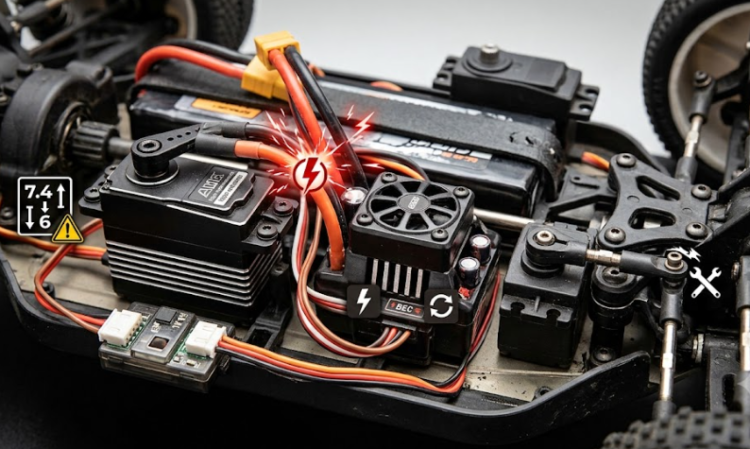
In most electric RC cars, the receiver and steering servo don’t have their own battery. The ESC has a small voltage regulator called a BEC (battery eliminator circuit) that steps the main battery voltage down to power them.
A BEC can only supply so much current at its rated voltage. Once demand goes past that, the BEC voltage drops quickly, and the receiver needs a minimum operating voltage to keep running. When the voltage dips below that line, the receiver shuts off for a split second and restarts. The servo then glitches as the receiver comes back to life and re-centers it. This is called a brownout. Some Spektrum receivers show it with a blinking light.
You may also notice the car stutters or briefly loses throttle, since the receiver goes into failsafe during the dip. One forum poster described a juddering launch under hard acceleration that matched exactly this: the receiver went into failsafe with full brakes and straight steering, then recovered as soon as the voltage came back.
Could My Servo Be Drawing Too Much?
A fast, high-torque digital servo asks the BEC for much more current than a basic one. Many ESC builders size the BEC for a modest servo, and a power-hungry replacement can push it past its limit. Several forum threads trace glitching to exactly this: a servo upgrade on a stock ESC. Some builders point to Castle and Traxxas-style setups as particularly sensitive to these dips.
Two other servo issues can look the same:
- Servo hitting its end of travel. If the linkage lets the servo push past where the steering can actually move, it can demand a large amount of current and pull the voltage down. Check that nothing binds at full lock.
- High-voltage servos. A servo rated for 7.4V on a 6V BEC runs weaker and may behave differently under load. A capacitor won’t raise the output voltage the way an external BEC does.
How I’d Check Power and Connections First
I wouldn’t start by adding parts. A few things are free to check:
- Battery charge and condition. A battery that isn’t fully charged can let the servo pull the voltage down far enough to cause trouble. A worn battery or one with a low discharge (C) rating sags harder when the motor pulls current, so try a fresh, fully charged pack.
- Connectors. Look at the battery plug, the ESC-to-motor connection, and the three-wire lead from ESC to receiver. A corroded or loose contact adds resistance and makes the voltage fall further under load.
- Wire damage. One owner found ESC wires pinched against the servo mount. Check for bare spots where insulation rubs on metal.
- Linkage and steering stops. Turn the wheels by hand with the power off and look for binding.
- A different servo. If a known-good, lower-draw servo stops the glitching, the original servo or its current draw is the problem.
Adding a Glitch Buster Capacitor
A glitch buster (also sold as a receiver capacitor or voltage protector) is a large capacitor on a servo-style lead that plugs into an empty receiver channel. It stores a little energy and releases it during a voltage dip, so the receiver keeps running while the BEC recovers. The low ESR rating matters if you build your own.
Match the capacitor’s polarity to the receiver plug (negative, positive, signal), and don’t connect it where the voltage could exceed its rating. Sizes people mention vary. One builder made his own with a 1000 µF capacitor, and another test of a Castle ESC found that a 4700 µF glitch buster plugged into the receiver was not quite adequate, so a capacitor doesn’t always solve the problem alone. Whether it works depends on the ESC, servo, and receiver.
When an External BEC Makes More Sense
If a capacitor doesn’t quiet the steering, or you’re running a high-voltage servo, an external BEC draws power straight from the main battery and feeds the receiver and servo. A 10-amp BEC from Castle Creations is one example forum users mention for this problem. Details to get right:
- Follow the BEC maker’s wiring diagram.
- Take the red power wire out of the ESC’s lead to the receiver when you add an external BEC. Leaving it in means two power sources feed the same receiver, and some owners warn that this can damage the ESC.
- Confirm the receiver and servo are rated for the BEC’s output voltage. One user’s receiver was rated for 3.5 to 9.6V. Others are not.
Could Radio Noise Be the Problem?
If the steering still glitches after the power side is sorted out, I’d look at noise. Routing the receiver antenna and servo wires away from the motor and ESC power leads is easy to try. A damaged antenna wire, or one pressed against a carbon fiber chassis, is also worth a closer look, since a weak signal can look like random servo movement. A ferrite choke on the receiver lead is another option. An article on receiver power describes the choke as a way to block high-frequency switching noise from the BEC without stopping the lower-frequency servo current pulses.
Noise is harder to prove than a voltage dip, which is why I’d leave it until the cheaper checks are done.
You might also like:
👉 RC Car Steering Motor Works Briefly Then Stops? Here’s Why
👉 RC Car Steering Issue With Turbo Controllers and 25GA Motors
👉 How to Fix RC Car Steering Problems Fast
What to Try Next
If the capacitor and external BEC haven’t helped, the problem might not be power at all. Swapping the receiver or the ESC, one at a time, shows which part is responsible. One forum owner ended up chasing a bad receiver through several ESCs before figuring that out. It’s slow, but it narrows things down.