
Drone Battery Voltage Drop on Throttle: Is It the Battery or the Connector?
A drone battery voltage drop on throttle is called voltage sag, and it does not always mean the battery is finished. Every LiPo sags when the motors pull hard. The question is how much, and whether the cause is the pack, the connector, the solder joints, or cold weather. Check those four before you spend money on a new battery.
Why Voltage Drops When You Add Throttle
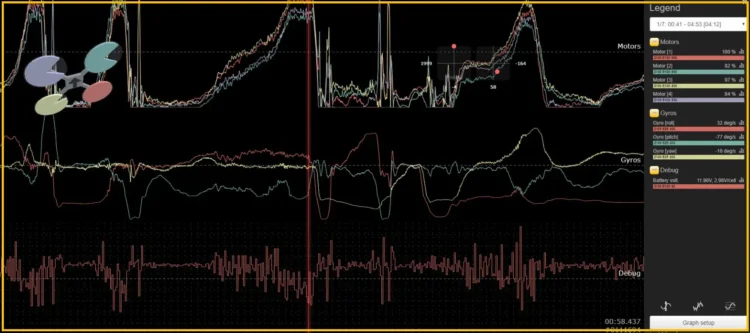
Opening the throttle makes the motors draw a large burst of current. That current passes through the battery’s own internal resistance, then the connector, the wires, and the solder joints on the ESC. Each of them loses a little voltage, following the basic rule that voltage lost equals current times resistance.
Your OSD reads the voltage after all those losses, so it shows a number lower than the pack’s resting voltage. When you pull the throttle back, the current falls and the voltage climbs again. A drop that recovers within a second or two is sag. A pack that stays low after you land is simply empty.
Could It Be the Battery?
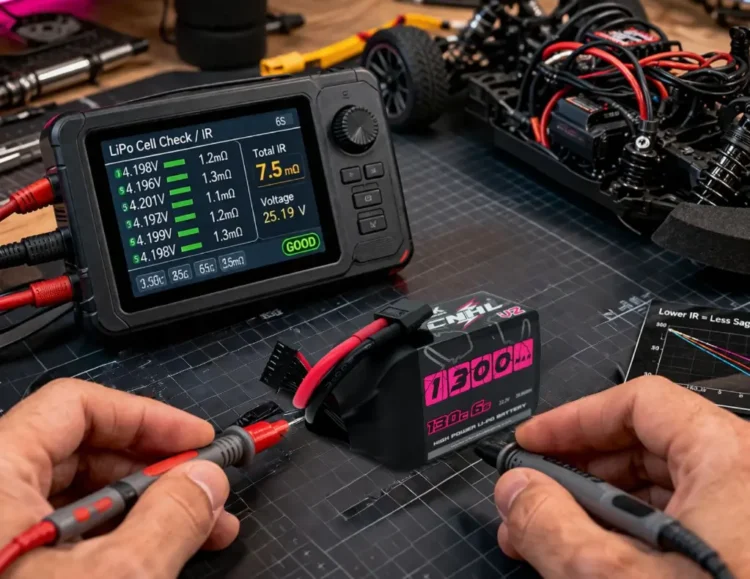
A worn battery has higher internal resistance (IR), so it sags more. You can measure this instead of guessing. Chargers such as the ISDT Q6, ToolkitRC M6, and HOTA D6 report IR for each cell. UAVModel’s voltage sag troubleshooting guide suggests charging the pack to storage voltage (3.85V per cell) and then running the IR test, writing down each cell’s value.
The same guide gives these rough bands per cell:
| IR per cell | What it suggests |
|---|---|
| 2–6 mΩ | Close to new |
| 7–12 mΩ | Acceptable, with mild sag on hard punches |
| 13–18 mΩ | Degraded; better suited to gentle flying |
| 19 mΩ and up | Potentially heavily degraded; investigate further |
These are one source’s guidelines, not a standard, and the right cutoff depends on pack size and how hard your quad pulls. Readings also vary by charger, pack temperature, and battery condition. Compare packs of similar capacity, age, and use history under the same conditions rather than relying on a single cutoff. If one pack sags much more than its siblings, it may be the problem. Replace a pack if its performance has deteriorated significantly or it shows signs of damage.iblings, that pack is the problem. If all of them sag about the same, look somewhere else.
Could It Be the Connector or Solder Joints?
A new battery can still sag badly if the path between it and the ESC has high resistance. UAVModel describes a melted XT60 housing where the pins had shifted and lost contact area, with resistance rising from under 1 mΩ to 50 mΩ or more. At 80A, 50 mΩ works out to a 4V drop at the connector alone.
Look at both the battery-side and quad-side plugs:
- Disconnect the battery and inspect the plastic around the pins for discoloration or warping.
- Look for black carbon marks, corrosion, or damaged metal contacts.
- Check whether the connector feels loose or shows signs of intermittent contact. Do not deliberately wiggle a live power connection to test it.
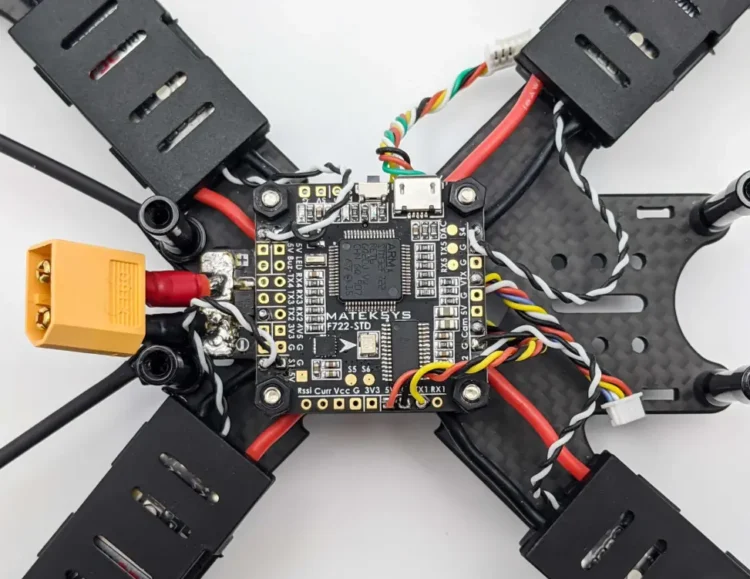
- Inspect the joint where the battery lead meets the ESC pads. A dull, gray, or ball-shaped joint may indicate a poor solder joint and can add resistance. A good joint is typically smooth and properly wetted to the pad and wire.
If you suspect an intermittent connection, use an appropriate electrical test method. Remove the propellers before performing powered bench tests, and avoid shorting the battery terminals.
Wire gauge and length play a part too. UAVModel recommends 12AWG leads as a minimum for a 5-inch build with 80–120A bursts and suggests keeping the lead short. Thin wire on a power-hungry build adds resistance of its own.
If every pack you own sags about the same, the connector and wiring are the first place to look. The fix is a few dollars and some careful soldering.
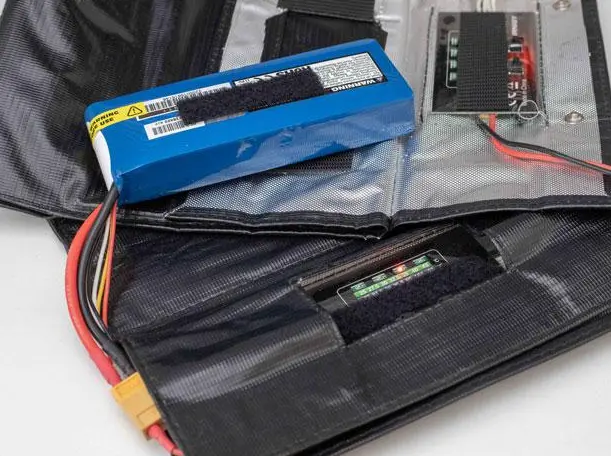
Cold Weather Makes It Worse
Cold slows the chemistry inside a LiPo and raises its internal resistance. UAVModel’s figure is that a pack at 5°C can have roughly triple the IR it has at 25°C, which should be treated as a ballpark. A winter pack that seems to be dying may only be cold.
Keep packs in an inside pocket or a warming bag until you plug in, and aim for roughly 25–30°C. If the sag disappears on a warm day with the same battery, temperature was the cause.
Do You Need a Capacitor or Betaflight Sag Compensation?
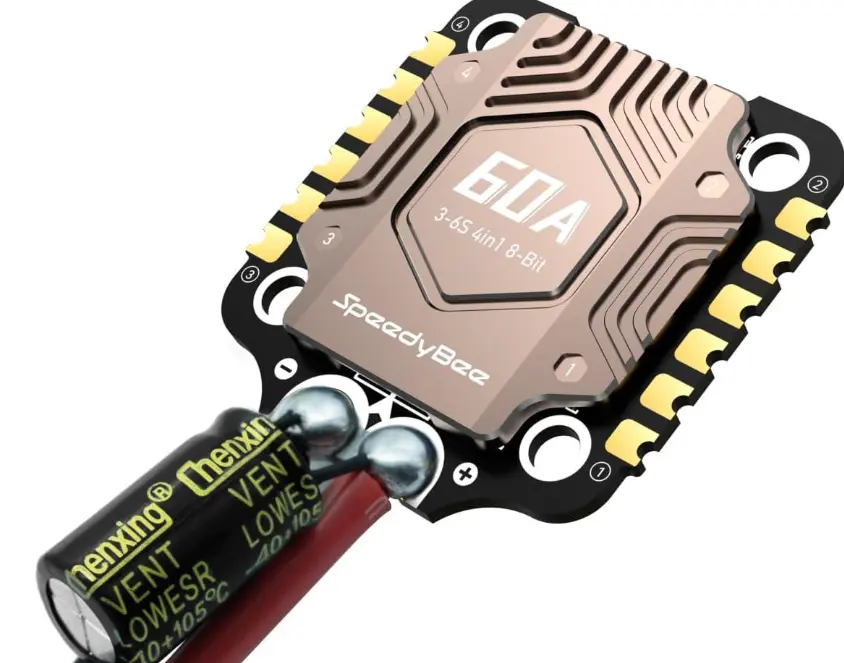
A low-ESR capacitor on the ESC power input is a common addition to smooth out voltage spikes. It helps with spikes on the supply, though, and it won’t fix a battery with high IR or a bad connector. Whether you need one depends on the ESC and the build.
Betaflight has a setting called vbat_sag_compensation that adjusts motor output as voltage falls, so the throttle and PID response feel more consistent through the pack. The Betaflight 4.2 tuning notes describe it as dynamic battery sag compensation, and the setting is off by default (a value of 0). It works from your configured battery voltage settings, so confirm those are correct on the Power tab first. The compensation only changes how the quad responds. The voltage itself still sags, so you still need to find the physical cause.
Landing Based on Resting Voltage
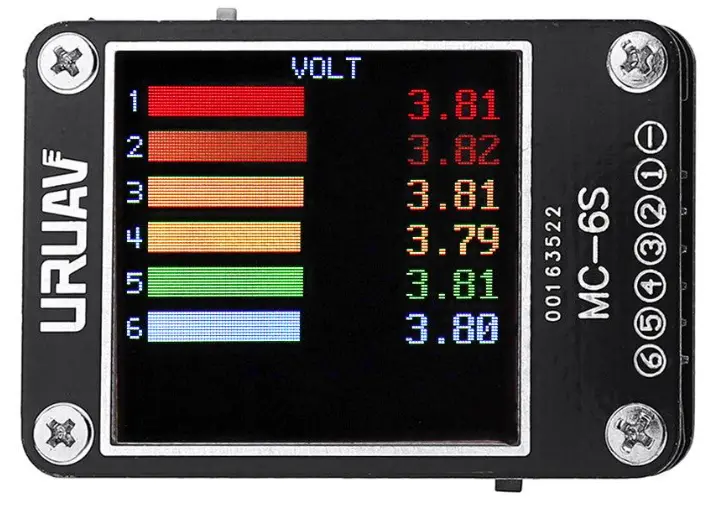
Voltage read under load is lower than the pack’s resting voltage. UAVModel recommends judging a pack by its resting voltage after landing, around 3.5V per cell or higher, instead of by the loaded number on the OSD. A reading of 3.3V mid-punch can recover well above that once the motors stop.
Resting voltage is useful for estimating remaining charge, but it should not be your only landing criterion. The appropriate landing threshold depends on the battery, its condition, and flight conditions. Follow the battery manufacturer’s guidance, set conservative OSD warnings, and land before the pack is excessively discharged. Remember that a voltage reading under load reflects voltage sag as well as the battery’s state of charge.
One more thing worth ruling out is the prop and motor combination. Heavier or higher-pitch props pull more current, so a setup that sags on one prop may behave differently on another. That depends on the motor and ESC, so change one thing at a time.
Related Posts:
👉 Drone Motors Beeping and Won’t Arm? Start With the Arming Flags
👉 Best Drone Under $300 That Actually Feels Worth It
👉 Best Foldable Drone That’s Actually Worth Packing
A Quick Order of Checks
Start with a visual inspection of the battery connector, wiring, and solder joints with the battery disconnected. Then compare the internal resistance readings of similar packs under consistent conditions. If the problem appears temperature-related, compare results only after the packs have reached appropriate operating temperatures.
Replace a battery when its condition or performance indicates that it is no longer safe or reliable to use. If the battery checks out but voltage still drops excessively, investigate the wiring, connector contacts, ESC, and current draw from the motor-and-propeller combination.
If the numbers look fine and the voltage still collapses, the problem may be in the wiring or ESC, which is a harder question and not one a single reading can settle.