
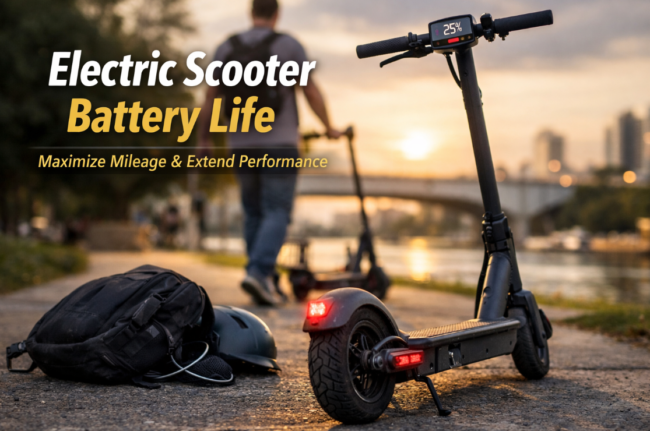
A couple years ago, my scooter died halfway to work.
Battery said 25%. I figured I was fine.
I was not fine.
There I was, pushing 40 pounds of very expensive regret down the sidewalk. That was the day I realized something important:
It wasn’t my battery that was the problem.
It was me.
After digging into how lithium-ion batteries actually work (and making some small habit changes), I increased my real-world range by about 15–20%. No new battery. No upgrades. Just smarter usage.
If you ride daily — commuting, running errands, weekend cruising — this stuff matters.
Let’s break down what actually works.

What “Battery Life” Really Means (Most People Get This Wrong)
When people say “battery life,” they usually mean one of two things:
- How far they can ride on one charge (range)
- How many years the battery lasts (lifespan)
Those are not the same thing.
Most electric scooters use lithium-ion batteries rated for roughly 300–1,000 full charge cycles. A cycle doesn’t mean one plug-in. It means using 100% of the battery’s capacity — whether that’s all at once or spread across partial charges.
Here’s what I learned the hard way:
Gradual range loss after a year is normal.
Sudden performance drops? Usually habit-related.
The Charging Mistakes I Used to Make
I treated my scooter battery like an old-school gas tank.
That was mistake #1.
I Used to Drain It to 0%
Bad idea.
Lithium-ion batteries hate being fully drained. Doing it occasionally won’t kill it — but doing it regularly absolutely speeds up degradation.
Now I recharge around 20–30%.
Since changing that habit alone, I’ve had far more consistent range.
Small adjustments now = fewer expensive problems later.
I Also Charged to 100% Every Single Night
Another habit I changed.
Charging to 100% is totally fine before a long ride. But doing it every day? That keeps the battery sitting at maximum stress voltage.
Now I keep it between 20% and 80% for daily commuting.
Most modern scooters (especially app-connected ones) allow charge limiting. If yours does, use it.
This one change alone can extend long-term battery lifespan significantly.
I Almost Bought a Cheap Third-Party Charger
Glad I didn’t.
Voltage inconsistencies might not show up immediately — but over time they damage cells.
Stick with the manufacturer-approved charger. Saving $20 isn’t worth shaving months (or years) off your battery.
Riding Style: The Hidden Battery Killer
This surprised me the most.
Your throttle behavior matters more than you think.
Aggressive Acceleration = Faster Drain
Every time you gun it from a red light, the battery dumps energy fast.
When I switched to smooth roll-on acceleration, my daily range noticeably improved. Not dramatically overnight — but enough that I stopped stressing about getting home.
Think of it like driving a gas car. Flooring it everywhere tanks your MPG.
Same idea here.
Eco Mode Isn’t “Lame” — It’s Smart
I used to avoid eco mode because I didn’t want to feel slow.
Now? I use it constantly for city riding.
It limits peak draw and keeps speed consistent. For commuting, it’s honestly the sweet spot between efficiency and practicality.
Efficiency isn’t just about battery — it’s about the whole riding system.
Weight Matters More Than We Admit
Groceries. Heavy backpack. Extra gear.
It all adds up.
You can’t magically lose body weight overnight — but trimming unnecessary cargo does help. Even small reductions improve efficiency over time.
Temperature: The Silent Battery Destroyer
This one is huge.
Heat Is Brutal on Lithium Batteries
Leaving your scooter in a hot car?
Direct summer sun for hours?
That accelerates chemical aging inside the cells.
I store mine indoors now. Always.
It’s one of the easiest long-term battery preservation moves you can make.
Cold Weather Range Drop Is Normal
If you ride in winter and think your battery suddenly sucks — it probably doesn’t.
Cold temporarily reduces performance.
What you shouldn’t do is charge it while freezing cold.
Let it warm up to room temperature first. Charging a frozen lithium battery can cause internal damage.
Long-Term Storage (Almost Nobody Does This Right)
If you’re not riding for a few weeks:
Do NOT store at:
- 0%
- 100%
Store around 50–60%.
This reduces internal stress during inactivity.
I didn’t know this my first year. Learned it after noticing range loss after winter storage. Since switching to mid-level storage, my off-season degradation has been minimal.
When It’s Actually Time to Replace the Battery
Even with perfect care, batteries don’t last forever.
Warning signs:
- Major range drop (like 40%+ suddenly)
- Random shutdowns
- Charging takes way longer than normal
- Battery drains unusually fast under light load
Before replacing:
- Check warranty
- Compare battery cost vs. new scooter cost
Sometimes a replacement makes sense. Sometimes upgrading does.
But in most cases? Poor habits — not failure — are the real issue.
What Actually Increased My Mileage (Real Results)
After changing:
- Charging between 20–80%
- Avoiding full discharges
- Smoother acceleration
- Using eco mode more
- Storing at 50–60% in off-season
- Keeping it out of extreme heat
I consistently gained about 10–20% real-world range.
No gimmicks. No expensive upgrades.
Just better habits.
Maximizing electric scooter battery life isn’t technical wizardry.
It’s discipline.
Charge smarter. Ride smoother. Respect temperature. Store correctly.
That’s it.
The difference between replacing your battery in one year vs. three or more? Usually daily habits.
And trust me — pushing a dead scooter home once is enough motivation to start doing it right.