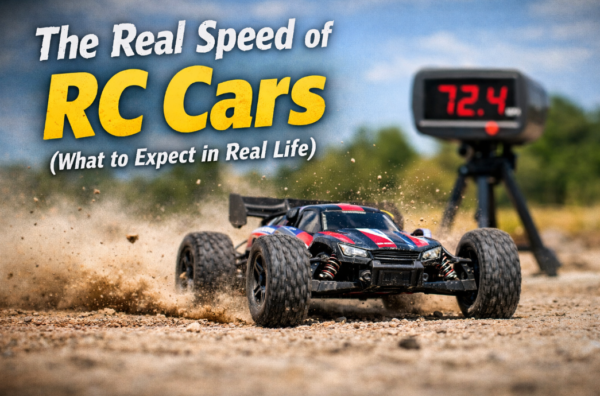
The Real Speed of RC Cars (What to Expect in Real Life)
If you’ve ever shopped for RC cars online, you’ve probably seen some wild speed claims.
60 mph. 70 mph. Sometimes even higher.
I remember staring at those numbers when I bought my first “fast” RC car and thinking, “There’s no way this thing actually does that in real life.”
Spoiler alert: I wasn’t wrong — but it also wasn’t a scam.
After years of driving, breaking, fixing, and writing about RC cars, I’ve learned that RC car speed is a lot more complicated than whatever number is printed on the box. In this post, I want to explain what those speed claims really mean, what you should realistically expect, and how to avoid the disappointment a lot of beginners run into.
What RC Car Speed Claims Really Mean
Manufacturers love advertising top speed. And technically, they’re usually telling the truth. The problem is how those speeds are achieved.
Most advertised speeds are measured under perfect conditions:
- Fully charged, high-quality batteries
- Smooth asphalt or test tracks
- Ideal gearing
- Sometimes even optional upgrades that don’t come in the box
On top of that, those speeds are often hit for just a few seconds — not during normal driving. In real-world use, things are very different.
Real-World Factors That Actually Affect RC Car Speed
Battery Type and Condition
From my experience, nothing affects real-world speed more than the battery. A decent LiPo battery can make the same RC car feel like a completely different machine compared to a basic NiMH pack.
Battery health matters too. An older battery with voltage sag can easily knock several mph off your top speed, even if everything else stays the same.
Terrain and Driving Surface
Most speed tests happen on smooth pavement. Real life? Not so much.
Grass, dirt, cracked asphalt, gravel — all of these slow your car down. A 60 mph RC car on paper might feel closer to 35–40 mph on rough ground, and that’s totally normal.
This is probably where most people feel disappointed, but it’s just physics.
Gearing and Setup
Gearing has a massive impact on speed, and it’s something I learned the hard way. Higher gearing can increase top speed, but it also puts extra stress on the motor and electronics.
Chasing speed without understanding setup is a fast way to overheat motors or fry ESCs.
Driver Skill and Control
This part doesn’t get talked about enough. Driving a fast RC car is a skill.
A lot of beginners never actually reach top speed because the car becomes unstable or scary to control long before that point. And honestly, that’s okay.
How Fast Are RC Cars in Real Life?
Based on my own driving and testing, here’s what I think is realistic:
- Entry-level hobby-grade RC cars: about 20–30 mph
- Mid-range models: around 35–45 mph in good conditions
- High-end performance builds: 50+ mph, but only with proper setup, space, and experience
One thing people forget is scale speed. A 1/10 scale RC car doing 40 mph looks insane. Your brain isn’t used to seeing something that small move that fast.
Should You Chase Top Speed or Real Performance?
Personally, I think focusing only on top speed is a mistake — especially if you’re new to RC cars.
Acceleration, handling, and reliability matter way more for enjoyment. A controllable 35 mph RC car is far more fun than a 60 mph missile you’re afraid to drive.
Speed runs can be fun if you know what you’re doing and have the right space. Just don’t expect those extreme numbers to reflect everyday driving.
My Honest Take on RC Car Speed
I used to think faster automatically meant better. Over time, that mindset changed.
Now, I care more about consistency and drivability than headline speed numbers. A car that feels solid, predictable, and fun is always the one I end up driving the most.
If you go into RC cars expecting the box speed to match real life, you’ll probably be disappointed. But once you understand what those numbers really represent, RC cars become way more impressive — and way more fun.
Frequently Asked Questions
Do RC cars really go as fast as advertised?
Yes, but usually only under ideal conditions. Real-world driving is almost always slower.
Is a faster RC car always better?
In my opinion, no. Faster cars are harder to control, maintain, and repair.
What’s a good speed for a beginner?
Around 25–30 mph feels exciting without being overwhelming.
Can upgrades significantly increase real-world speed?
They can, but upgrades also increase cost, complexity, and the risk of breaking parts if you’re not careful.
At the end of the day, the real speed of RC cars isn’t about numbers — it’s about context.
Once you stop chasing unrealistic expectations, you start appreciating what these machines can actually do. If you’re buying your first RC car or thinking about upgrading, focus on real-world performance, not just the advertised top speed.
That approach will save you money, frustration, and probably a few broken parts too.