Why RC Batteries Swell (And When to Worry)
RC Batteries Swell (And When to Worry)
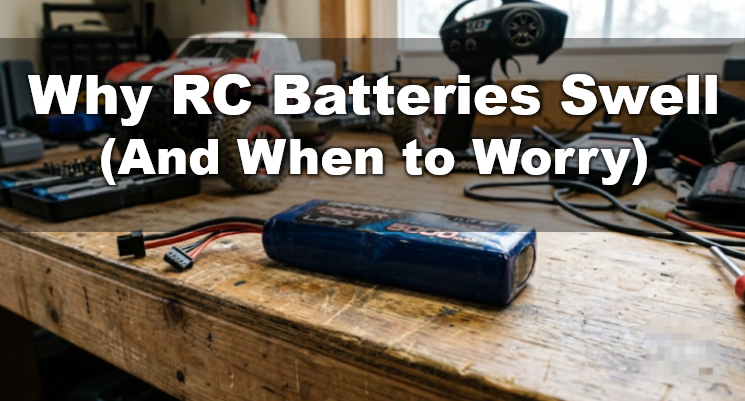
I noticed the first bump on the side of my Traxxas pack about a week after my daughter and I ran it through three straight afternoons of backyard bashing. It wasn’t dramatic, just a slight curve where the case used to be flat, but it was enough to make me stop and actually look up what was going on instead of just shrugging it off like I usually do.

Why Does This Even Happen?
That’s the question that sent me down a two week rabbit hole. Every RC forum I found had a different theory, half of them contradicting each other, and none of them explained it in a way that made sense to someone who just wants to keep his kid’s favorite truck running without setting the garage on fire. So I started testing things myself, comparing notes with guys at the local track, and slowly piecing together what was actually true versus what was just internet folklore.

What I Used to Believe
Honestly, for the first year or two I owned RC vehicles, I figured a swollen battery pack was basically cosmetic. A little puffy, still holds a charge, still powers the truck, so who cares. I kept using packs that looked slightly rounded because they still worked fine on the driveway, and nothing bad happened, so my theory seemed confirmed every single time.
I also assumed swelling only happened to cheap batteries. I run some higher end packs in my bigger trucks, the kind of setup you’d see if you read through my Arrma XRT vs Traxxas X-Maxx comparison, and I genuinely thought premium gear was immune to this kind of thing. That assumption did not survive contact with reality.

The Moment My Thinking Changed
What actually flipped my opinion was a single afternoon where I ran the same pack twice in a row without letting it cool, then plugged it straight into the charger while it was still warm from the second run. By the next morning the case had ballooned noticeably on one side. That was the moment I stopped treating this as a minor cosmetic quirk and started treating it as a real warning sign.
I went back and checked every pack I owned. Two of them, both used heavily during a stretch when I was testing high current setups similar to what I described in my Kraton 6S vs Maxx write-up, already had the same subtle curve I had been ignoring for months. Once I knew what to look for, I saw it everywhere, and I felt a little embarrassed I hadn’t caught it sooner.

The Real Reasons RC Batteries Swell
Heat Buildup From Hard Use
Lithium batteries generate internal heat under heavy load, and RC vehicles push that load harder than almost anything else you’d plug a battery into at home. Six second full throttle bursts followed by an immediate reverse and another launch might be fun for your kid to watch, but it’s brutal on the internal chemistry of the pack. Repeated heat cycles without proper cooldown time slowly stress the cell walls until they start to bulge.
Overcharging Or Charging Too Hot
Plugging a warm battery straight into a charger is one of the most common mistakes I made for years without realizing it. Charging adds its own heat on top of whatever heat is already trapped inside the cells from the run before, and that combination is a fast track to swelling. Letting a pack rest until it’s genuinely cool to the touch sounds tedious, but it made a noticeable difference once I started actually doing it.
Age And Cycle Count
Every battery has a lifespan measured in charge cycles, not just calendar time. A pack that’s been through two hundred aggressive charge and discharge cycles is going to behave very differently than a fresh one, even if it looks identical on the outside. Swelling near the end of a battery’s useful life is close to unavoidable, and honestly it’s a fair trade for all the driveway time you got out of it.
Deep Discharge Damage
Running a pack down until the truck barely crawls, instead of stopping at a reasonable voltage cutoff, puts serious strain on the individual cells. I used to let my daughter drive until the truck basically died on its own, thinking that was the most efficient use of a charge. Turns out that habit was quietly shortening the life of every pack I owned.

What I Do Differently Now
I let every pack cool to room temperature before it goes anywhere near a charger, no exceptions, even when we’re in the middle of a fun afternoon and waiting feels like torture for a six year old who wants to keep driving. I also check each battery by hand before every session now, running a thumb across the flat sides to feel for any curve that wasn’t there before. It takes about ten seconds and it’s saved me from a couple of situations I really did not want to deal with mid-run.
I stopped running packs all the way to empty too. Most chargers and receivers have a low voltage cutoff option, and turning that on was one of the simplest changes that made a real difference in how long my batteries stayed flat and healthy.
When Swelling Means Stop Immediately
A slight, barely visible curve is one thing. A pack that’s visibly puffed, warm to the touch even after sitting untouched, or has any kind of discoloration on the casing is a completely different situation. That battery needs to be disconnected, placed somewhere non-flammable, and retired for good. I know it stings to toss a pack that still technically holds a charge, but the alternative isn’t worth the risk, especially with a curious kid running around the garage.
My Honest Verdict After Living With This
I went into this expecting a straightforward explanation and a quick fix, and instead I came out with a completely different relationship with how I treat my batteries day to day. The swelling itself isn’t some rare malfunction, it’s usually the predictable result of heat, charging habits, and normal aging catching up with the pack all at once. Once I understood that, the whole thing stopped feeling random and started feeling manageable. My trucks still get plenty of abuse on the weekends, but my batteries last noticeably longer than they used to, and that alone made the whole rabbit hole worth it.