Longest Endurance Hybrid Drones and What the Numbers Mean
Longest endurance hybrid drones all seem to come with the same asterisk on the spec sheet, and it’s payload. The headline says five hours. The fine print says five hours with nothing attached, which is mostly a drone carrying fuel and not much else.
A battery-powered multirotor tops out somewhere around 30 to 45 minutes, so the jump to several hours is real. I’d just read the big number as a ceiling and go straight to the payload line, because that’s the figure that tells you what you’d actually be flying.
What Counts as a Hybrid Drone?
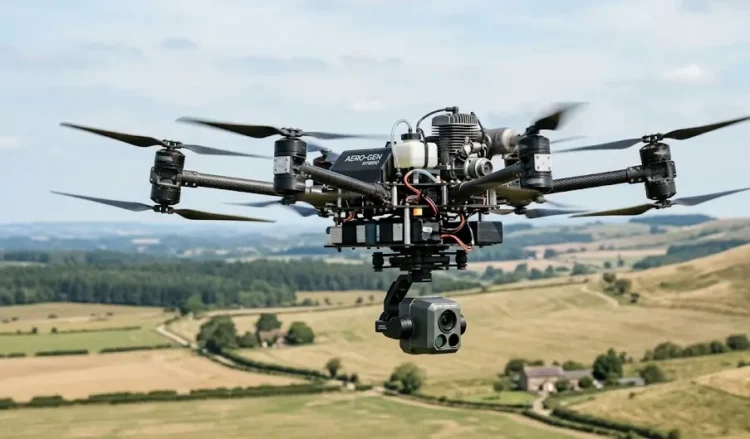
The word gets used for two different things. One is a gas-electric multirotor: a small gasoline engine spins a generator, and the electricity runs the same brushless motors and props you’d find on any quad. It hovers like one too. The other is a hybrid VTOL, which lifts off like a multirotor and then transitions to flying like a plane. VTOLs are built for long, straight routes and sit in a different price and mission class, so I’m leaving them out here.
The reason the gas-electric setup works at all is energy density. Gasoline holds far more energy per kilogram than a LiPo pack, and that gap survives the losses in a small engine and generator with room to spare.
Which Ones Fly the Longest?
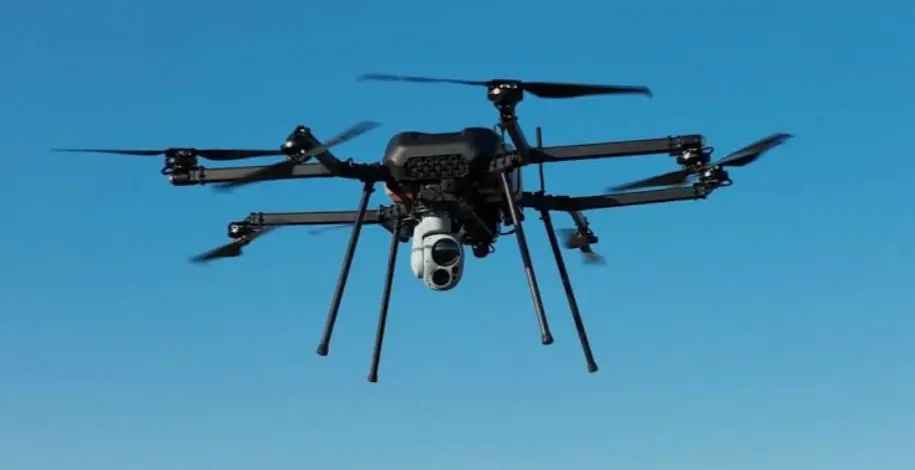
The Skyfront Perimeter 8 owns the record. In 2021 it stayed up for 13 hours and 4 minutes and covered about 205 miles. Some coverage says that flight carried extra fuel capacity beyond the standard setup, so I wouldn’t treat it as what a buyer gets out of the box. Skyfront’s own listing for the standard Perimeter 8 is about five hours with no payload, around three hours at 4 kg, and an hour at 7.5 kg. As far as I can tell from Skyfront’s write-up, nobody has beaten the record since.
The Acecore Noa Hybrid, from the Netherlands, is the one that comes closest on paper for a production hexacopter. Acecore lists 265 minutes with the larger tank option and 175 with the standard one. It can lose a motor and still land. With a 2.5 kg LiDAR sensor on board, one roundup puts it nearer 163 minutes, which shows how fast the number moves once something is hanging underneath.
Harris Aerial’s Carrier H6 Hybrid EFI is listed at up to 240 minutes, with a 25 kg takeoff weight and room for up to 5 kg of payload. Quaternium’s HYBRiX.20 from Spain is also listed at 240 minutes, and 120 minutes at its maximum 2.5 kg payload. Quaternium has been reported to fly over ten hours in a controlled test, but that’s a test flight, not a figure you’d plan a job around.
Every number above is manufacturer-stated and comes from good conditions. Wind, temperature and a real sensor will cut into them.
What Happens to Flight Time With a Payload?
The engine, generator, cooling and tank all weigh something before the first drop of fuel does any work, so the endurance curve falls off quickly as payload goes up. The Perimeter 8+ shows it well: five hours with no payload becomes about one hour at its 10 kg maximum. That’s the same airframe and the same fuel system, just a heavier load.
Weight has a second effect. The FAA’s small drone rules in the US draw their line at 55 lb, about 25 kg, and a few of these list a takeoff weight right at it. The standard Perimeter 8 is listed at 23 kg, while Harris and Quaternium list 25 kg. Weigh a fueled, loaded one before assuming it’s under the line.
Could You Actually Fly One?
These are enterprise machines. Prices run from tens of thousands of dollars up, and many are quote-only. You’d also be taking on engine maintenance, fuel handling, more noise and more vibration than an electric multirotor, plus a backup battery that’s only meant to get the aircraft down safely when the engine quits.
A long flight also gives the radio link, the receiver power and the failsafe settings a lot more hours to go wrong. I covered how antenna orientation, battery sag and failsafe setup cause signal loss in my post on why drones fall at long range on a Skywalker, and that reasoning carries over to any aircraft flying far from the pilot, hybrid or not.
Five years after the record, I’m still curious what a smaller, quieter version of this idea would even look like.